

Content Ops
How to Simplify Documentation Publishing for Software Product Releases
Learn practical ways to make documentation publishing lighter, faster, and far less stressful. This article looks at how to keep documentation perfectly aligned with product releases in three different continuous content delivery use cases: scaling out documentation, automated release-note generation, and a Docs-as-Code workflow.

Table of Contents
- What is a Software Release?
- The Challenge of Syncing Documentation with Releases
- Scaling Documentation to Keep Up With Releases
- How Fluid Topics Keeps Documentation in Sync with the Release
- Decoupling Content from Release Cycles with Continuous Delivery
- Internal Fluid Topics Use Case: Automatic Release Note Generation
- Fluid Topics Use Case: Docs as Code
- Post-Release Phase: Turning Feedback into Action
- What are the Best Documentation Practices for a Successful Software Release?
- Conclusion
Technical writers have been in this exact situation countless times: the clock is ticking down to a major software release, developers are finalizing code, and Quality Assurance (QA) is running final tests, leaving writers racing to document every feature and update every screenshot before the official launch.
Technical writers are the unsung heroes of software releases. They work with development and product teams throughout the Software Development Life Cycle (SDLC) to ensure the Document Development Life Cycle (DDLC) keeps pace with the roadmap.
This article breaks down practical ways to make documentation publishing lighter, faster, and far less stressful, highlighting how continuous content delivery, automated release-note generation, and a Docs-as-Code workflow help keep documentation perfectly aligned with product releases.
What is a Software Release?
A software release is a key step in the SDLC where development teams launch new features and make continuous improvements to software to support user needs and reflect technological innovations. Each release is accompanied by comprehensive documentation, guiding users on how to access, implement, and maximize the benefits of the update.
There are different types of releases:
- Major releases announce substantial changes, new features, or elements that significantly modify the software or user experience.
- Minor releases introduce smaller changes like new functionalities that don’t change the user’s workflow or improvements of existing features.
- Patch releases fix bugs or address security vulnerabilities. These smaller, continuous releases are essential for maintaining a robust, reliable system.
For documentation teams, understanding the type and scope of a release helps determine the level of effort, coordination, and content updates required.
The Challenge of Syncing Documentation with Releases
Product releases are complex, cross-team efforts where one missing detail or outdated instruction can delay release or cause user issues. As release cycles accelerate, the pressure on technical writers intensifies. Updates now happen more frequently than ever, and technical writers are expected to deliver detailed, accurate content across multiple platforms and endpoints simultaneously. When documentation falls behind, companies risk sharing outdated or incorrect information, causing user frustration, mistrust, and product downtime.
The core challenge is this: how can documentation keep pace with product evolution so that content is ready the moment a new release goes live?
Scaling Documentation to Keep Up With Releases
To tackle this, technical writers must ask themselves a few questions:
- How can we produce tech content in near real time so that we are ready when the product is ready?
- How can we deliver in sync with the product release?
There are two primary strategies for aligning content with rapid release cycles:
Scale Up: Hire more technical writers to generate more content. While this can work, it’s resource-intensive and may not keep pace with increasingly rapid releases.

Scale Out: Involve other roles in content creation. This approach requires an initial investment in shifting content operations workflows, but it allows companies to produce more diverse content faster. Technical writers set the guidelines and systems, empowering developers, engineers, and other team members to create content. Writers then act as editors, advisors, and copywriters, ensuring accuracy and clarity.

For this approach to succeed, writers should allow team members to create content using the tools they’re most comfortable with, rather than forcing everything into a single CCMS. Content can then be consolidated and delivered downstream through a centralized delivery solution.
How Fluid Topics Keeps Documentation in Sync with the Release
To migrate to a scale-out approach, teams need solutions that support content creation across various applications. Fluid Topics’ Product Knowledge Platform (PKP) is one such tool. It is built to optimize documentation publishing by aggregating and unifying all product and technical knowledge, no matter the initial source or format. Content created by developers, engineers, or other contributors using different authoring tools is easily ingested into the centralized repository alongside other documentation assets.
What sets Fluid Topics apart is its ability to automatically restructure this content so that, no matter where it came from, it appears to have originated from a single, consistent source. Headings, styles, metadata, and layouts are harmonized automatically, creating a seamless, coherent experience for users.
Once consolidated and standardized, Fluid Topics dynamically delivers the most relevant content to any digital channel, device, or application, tailoring the experience to match users’ contexts, needs, and environments.
Decoupling Content from Release Cycles with Continuous Delivery
A key advantage of Fluid Topics is its continuous content delivery approach, which allows technical writers to break free from rigid release schedules. Real-time publishing ensures content moves seamlessly from the backend to the frontend without waiting for IT or manual deployment processes. Writers work at their own pace and publish content any time, as soon as it’s ready, at the rate and frequency they need.
How It Works
Fluid Topics provides ready-to-use connectors that pull content directly from various sources. The platform automatically transforms and consolidates everything into a single, structured repository, ensuring consistent metadata and a clean foundation for delivery.
From there, teams can take advantage of built-in staging and review workflows. New or updated content remains private until it has been checked and approved, and reviewers can collaborate with authors directly through the platform. Once published, the content is delivered dynamically to any channel, so readers always get the latest version without waiting for a formal release. Therefore, writers deliver content at any time, including when new versions are released and in the periods between them. This gives the illusion that documentation is always synced with the product release, when in reality, it’s the decoupling of documentation from version releases that provides this flexibility.
Fluid Topics also supports controlled pre-release access. For example, documentation for an upcoming product or version can be shared early with support teams or selected stakeholders while staying hidden from the general public. Visibility rules can be adjusted at any time, making it easy to prepare content ahead of a launch and activate it the moment it’s needed.
The Benefits
With faster, automated content collection and integration, technical writers can share information in near real-time about new features, updates, or critical bug fixes without downtime. This approach not only keeps content aligned with fast-moving product cycles but also improves team productivity, reduces bottlenecks, and ensures users have reliable, and accurate information.
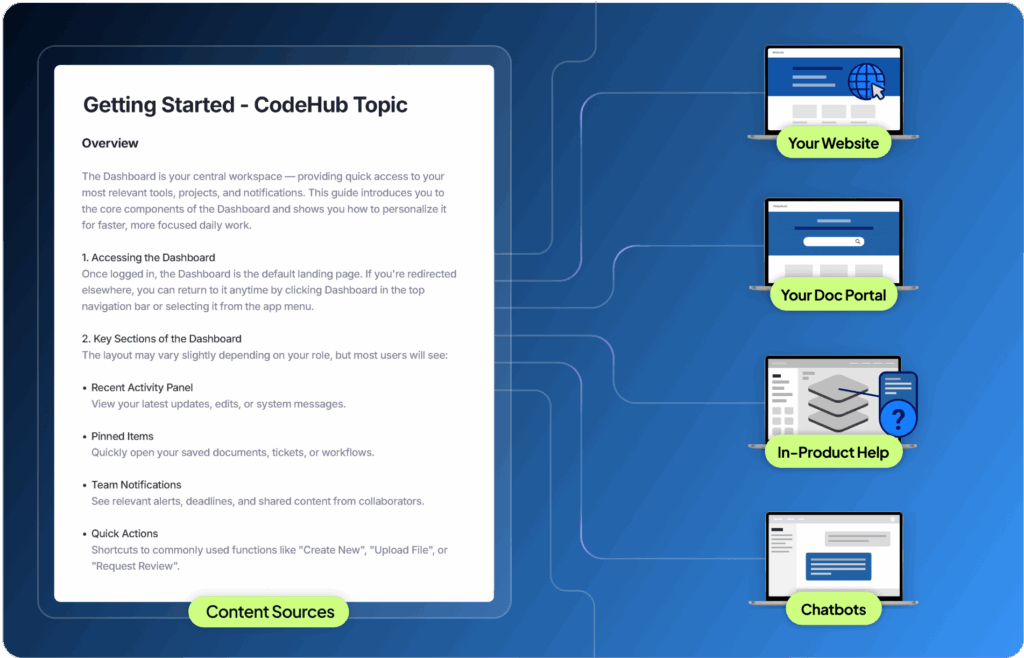
Continuous content delivery transforms the documentation workflow from a reactive, time-bound task into a proactive, integrated part of the product lifecycle.

We've saved up to two weeks in the documentation delivery process for large products, which helped us reach our goal of four-week release cycles. We couldn't have kept up with the pace without Fluid Topics.
Lonnye Yancey-Smith
Executive Manager of the Asset Lifecycle Intelligence Division, Hexagon
Internal Fluid Topics Use Case: Automatic Release Note Generation
Creating release notes manually is often slow, error-prone, and difficult to align with fast-moving product releases. Fluid Topics’ internal teams automate this process by integrating directly into Continuous Integration / Continuous Delivery (CI/CD) pipelines, ensuring documentation is always in sync with software updates.
How exactly can teams embed release notes into their CI/CD workflow with Jira?
The process:
- Developers tag each task in Jira (or another project management tool) with a Release Version Number.
- As code changes are committed and merged in the CI/CD pipeline, Fluid Topics’ bot automatically pulls all relevant Jira tasks associated with the latest version.
- The bot harmonizes content, organizes it according to a predefined release note template, and ensures formatting and metadata meet documentation standards.
- Draft release notes are delivered to internal stakeholders for review and validation.
- Once approved, the notes are automatically published to internal portals or public documentation systems without manual intervention.
Where CI/CD integration delivers real value:
- Each commit or merge triggers an automated extraction of related tasks.
- The pipeline ensures that release notes are always aligned with the current product build, reducing the risk of mismatched documentation.
- Automation reduces the need for developers or technical writers to manually compile notes at the end of a release cycle.
- The workflow can include automated checks for formatting, completeness, and metadata compliance, making release notes part of the same quality-controlled pipeline as the software itself.
By embedding release note creation directly into the CI/CD pipeline, Fluid Topics transforms it from a manual, after-the-fact task into a fully automated, synchronized part of software delivery.
Fluid Topics Use Case: Docs as Code
Technical writers who liked the idea of the scale-out approach will love this concrete application. Docs as code, also called DevOps-based documentation, is an alternative way to create and maintain technical documentation.
This approach treats documentation as software, using the same tools, workflows, and version control practices as development. By embedding documentation directly into the development process, it becomes an integral part of the product lifecycle.
Engineers and developers create content, such as API documentation, within their existing workflows and tools. They maintain it continuously as part of their normal development activities, leveraging their technical expertise and familiarity with the subject matter. Technical writers then review, refine, and standardize the content, ensuring consistency, clarity, and accessibility without slowing down the creation process.
What steps and tools can developers use in a docs-as-code approach?
- Developers write documentation in source control systems such as Git or SVN.
- Text-based formats like Markdown, YAML, AsciiDoc, or reStructuredText are used to maintain simplicity and version control.
- Documentation files remain in Git repositories, providing full traceability of changes.
- Content can be previewed with static site generators like Hugo or Jekyll before publication.
- Each commit in the CI/CD pipeline triggers the extraction and publication of related documentation via Fluid Topics’ Markdown connector, eliminating manual HTML conversion.
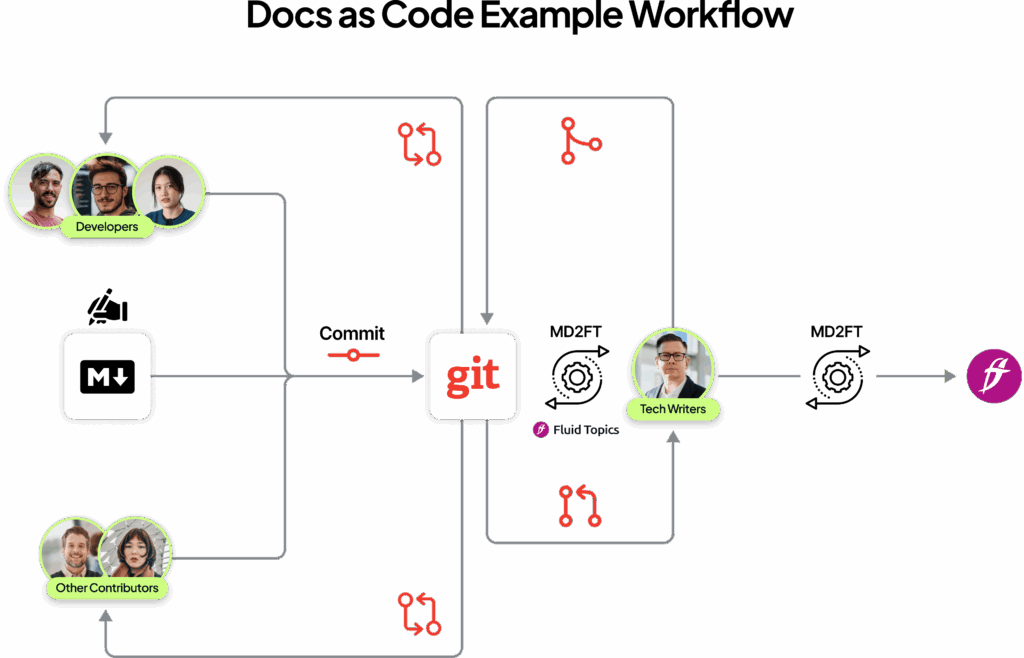
Teams should keep in mind that while efficient, switching to a docs-as-code approach has its challenges. This strategy has a steep learning curve for technical writing teams who must learn new skills to help maintain Git-based content. Additionally, managing content directly in Git means semantization and metadata are removed from native files. However, solutions like Fluid Topics combat this by enriching content with metadata, taxonomies, and dynamic tagging when gathering information into its content hub.
Post-Release Phase: Turning Feedback into Action
Once the release is live, the work doesn’t stop. Technical writers must collect user feedback, analyze documentation effectiveness, and prioritize updates.
Key questions include:
- Are new features clear to users?
- Can users find relevant information easily?
- Is the documentation clear and helpful?
Challenges Without Fluid Topics:
Feedback trickles in slowly, and content updates are labor-intensive. Writers must manually revise, republish, and distribute changes to multiple channels. As bugs are fixed and features evolve, this cycle can feel never-ending.
With Fluid Topics:
Fluid Topics provides built-in metrics and feedback mechanisms directly where the content is used. This allows teams to track how users interact with content by capturing each user interaction with high levels of detail and deep context to extract meaningful information. Detailed analytics, such as “searches with no results,” topic popularity, and ratings, help teams identify gaps and prioritize updates. Once changes are made, continuous omnichannel delivery automatically updates all endpoints in real time, eliminating manual republishing. Writers can focus on creating high-value content while users always access the most relevant, up-to-date information.
What are the Best Documentation Practices for a Successful Software Release?
Having successfully synced software releases and documentation publications is possible. Here are six best practices to implement for a more efficient documentation process during release time.
- Maintaining clear documentation: Design documentation with the reader in mind. Intuitive navigation, clear headings, and easy-to-find answers make the experience more helpful for users, reducing the support burden.
- Automating versioning: Version control systems help teams collaborate, review updates, and maintain an accurate history of revisions. Automating the creation of release notes for each version means writers can focus on producing supporting documentation for each product update.
- Integrating the docs with the CI/CD pipelines: When developers and engineers keep track of important updates and changes throughout their CI/CD workflows, this information is easy to extract and publish, without putting an additional burden on technical writers.
- Defining review and approval workflows: Clear approval workflows help automate tasks, clarify feedback, and keep teams productive, leading to better team alignment and faster content delivery.
- Ensuring content is easy to find: Continuous publishing allows teams to publish approved content automatically, anytime, and to all endpoints. This, combined with robust metadata management and an advanced search engine, helps users find any information in any application.
- Providing opportunities for user feedback: User feedback is essential for tracking and improving the value of documentation. With a direct line of communication, writers strategically prioritize content modifications to improve user self-service while extending the lifecycle of documentation.
Conclusion
Publishing documentation in sync with a software release doesn’t have to come loaded with stress and challenges. By adopting strategies like continuous content delivery, automated release-note generation, and a docs-as-code approach, technical writers can stay in lockstep with development teams, ensuring users always have access to accurate, timely, and relevant information. Platforms like Fluid Topics make this alignment feasible, centralizing diverse content sources, harmonizing formats, and delivering dynamic content across multiple channels all without slowing down the release cycle.
The result is more than efficiency; it’s a transformation of the documentation workflow from reactive to proactive. Technical writers become strategic enablers, scaling content production, reducing errors, and freeing teams to focus on high-value tasks. Users benefit from documentation that is not just complete, but instantly accessible, contextually relevant, and continuously updated.
In the end, simplifying software release documentation isn’t just about keeping pace—it’s about embedding documentation as an integral part of the product lifecycle. Each release then delivers clarity, consistency, and confidence for both teams and users alike.
For practical next steps, explore these resources:
Schedule a free demo of Fluid Topics with a product expert
Software Release FAQs
The software development lifecycle (SDLC) follows a structured path from initial concept to product or feature deployment. The typical stages are:
- Planning: Here teams define the scope, requirements, and timeline.
- Design: Then, engineering teams create technical specifications and architecture.
- Development: At this point, developers write the code.
- Testing: Here, various types of testers verify that the software works correctly. Technical writers can begin to prepare documentation throughout the testing phases.
- Deployment: The software moves to production, and the release note is published.
- Maintenance: Developers address post-release bugs, security patches, and improvements. Writers update documentation to reflect ongoing changes as necessary.