 5 Knowledge Management Trends Defining 2026
Industry Insights
Knowledge Management for AI: From Human to Agentic AI Enablement
Past conversations focused on how evolutions in AI might alter knowledge management, knowledge creation, and information classification. However, the real question is how to shift knowledge management to better enable Agentic AI workflows. Read on to learn how it's done.

Artificial intelligence isn’t just a technology; it’s the new audience and purpose of Knowledge Management. For the past two years, conversations have centered on how AI might alter KM through smarter content creation, automated tagging, and classification. Useful, yes, but incremental. Reshaping KM with AI is inevitable. The real issue is reshaping KM for AI, a shift that will transform KM for a new mission: Agentic AI enablement.
Knowledge Management for AI – The New Paradigm
KM has been designed around human needs. Its systems conventionally organize, store, and display information for people via intranets, document libraries, portals, and search engines. Agentic AI is rewriting the rules. As technology and use cases mature at unprecedented speeds, the primary consumers of enterprise knowledge are shifting from humans to robots and agents.
Agentic AI refers to AI systems composed of agents that can behave and interact autonomously in order to achieve their objectives.
The scopes of AI agents range from simple assistance to the automation of complex processes with limited or no human supervision. At a basic level, AI uses corporate knowledge to answer employees’ questions and deliver insights. More advanced agents orchestrate end-to-end processes as Agentic AI has the capability to complete complex tasks autonomously by interacting with different tools and systems.
This isn’t a look at the future to come. It’s happening now: line of business (LOB) applications are already offering embedded assistants and autonomous workflows: CRM solutions deploy AI SDRs (Sales Development Representatives) that handle full prospection cycles, help desk tools rely on AI agents to resolve cases, and operations platforms have built-in AI copilots.
In this new division of labor where AI filters, analyzes, and contextualizes information for humans, knowledge management will need to pivot from empowering people to powering agents. As a matter of fact, knowledge management must reposition itself as Agentic AI Enablement.
Implications for KM Information Architecture
The pre-requisite for agent performance is connecting to all available information, including siloed data and content scattered across the enterprise knowledge ecosystem.
Unified search has long been the KM solution to bridging silos: bring all knowledge into one place, put everything into a data lake, then query across it. Early “universal” chatbots replicated this approach and failed. Outside its original source and deprived of context, undifferentiated content lacks meaning, making it largely unusable for AI. Additionally, access rules are hard to transfer, updates are asynchronous, and interactions are limited to read-only experiences.
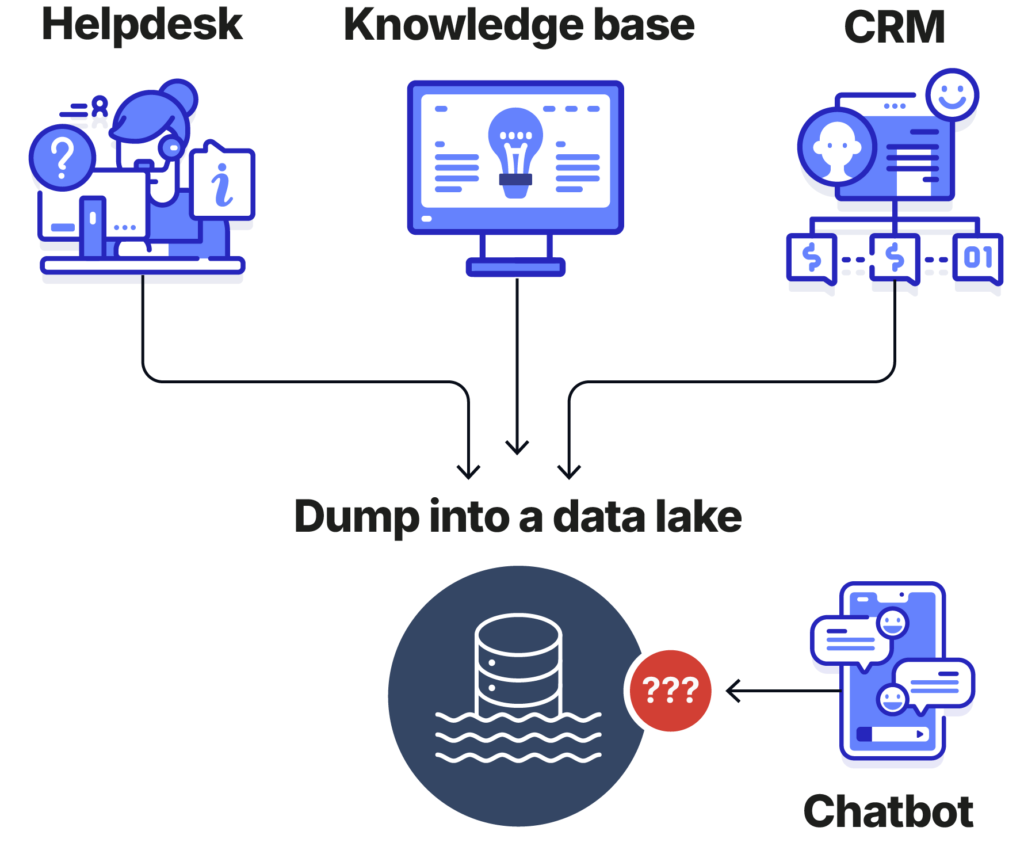
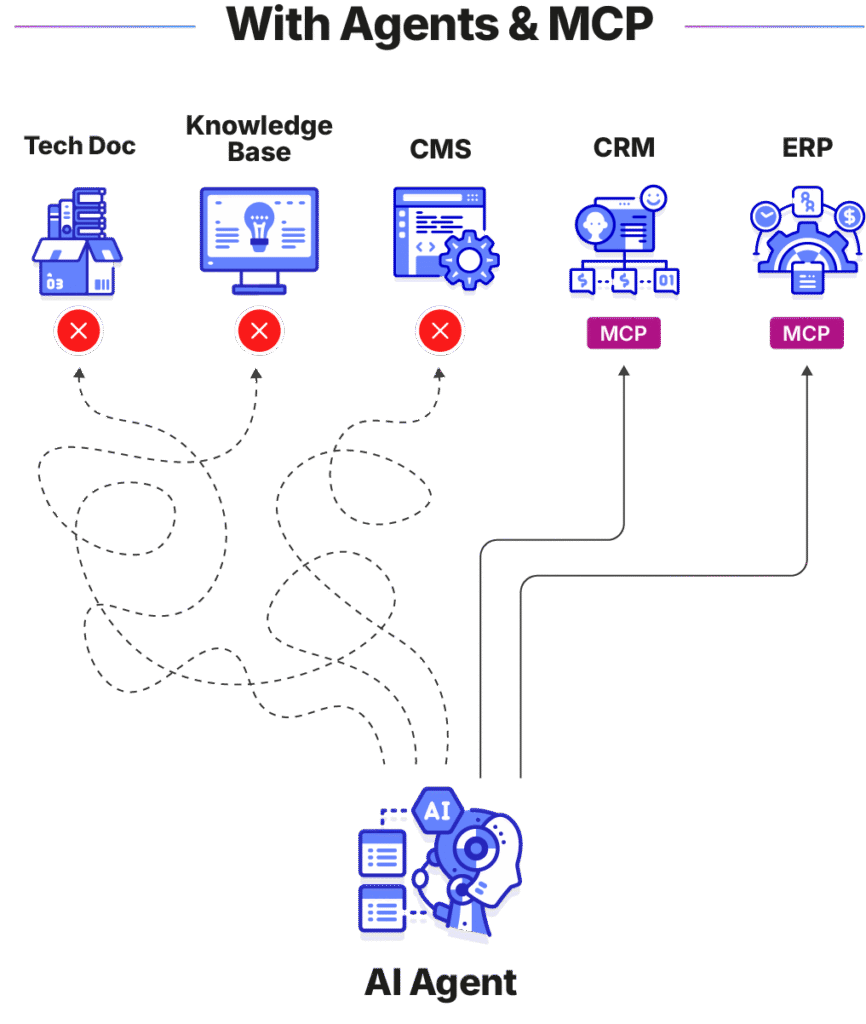
In 2025, AI evolved, opening a new way. LLMs grew into reasoning-capable LRMs, and MCP enabled agents to interact directly with business applications. Rather than dumping all knowledge into irrelevant data lakes, an agent now reasons towards its goal, retrieves what it needs directly from each source, and when appropriate, acts directly on those systems. This functions similarly to an ecosystem of expert services rather than a single self-service warehouse.
- Large Language Models (LLMs) are a category of AI trained on vast amounts of data, enabling them to understand and generate natural language as well as other types of content.
- A Large Reasoning Model (LRM) is an AI system that combines natural language understanding with logical reasoning to solve complex problems.
- The Model Context Protocol (MCP) is a protocol that standardizes how LRMs can query existing applications (both read and write).
The Need for Domain Knowledge
This technology is powerful in theory, but it needs clear guidance in practice. Just as humans turn to subject matter experts for specific inquiries, agents need a canonical reference for each business domain. To enable AI properly, it must be grounded in domain knowledge. The underlying information architecture must also reflect this by designating a referential authority source for each domain.
In some domains, mapping these references is straightforward. Authoritative systems that support LOB solutions, also known as systems of record, are the natural go-to applications: CAD and PLM for product design, CRM for sales and clients, ERP for HR and finance, and more. Their data is structured, enriched with domain semantics—ideal for AI—and they are now equipped with MCP servers.
However, beyond these business applications, content is less formal, loosely organized, and resides mostly in files. Knowledge is fragmented across PDFs and slides, often lacking structure or metadata. Sources are numerous and spread across shared drives, wikis, DMSs, cloud-based CMSs, and many repositories that are unlikely to support MCP anytime soon.
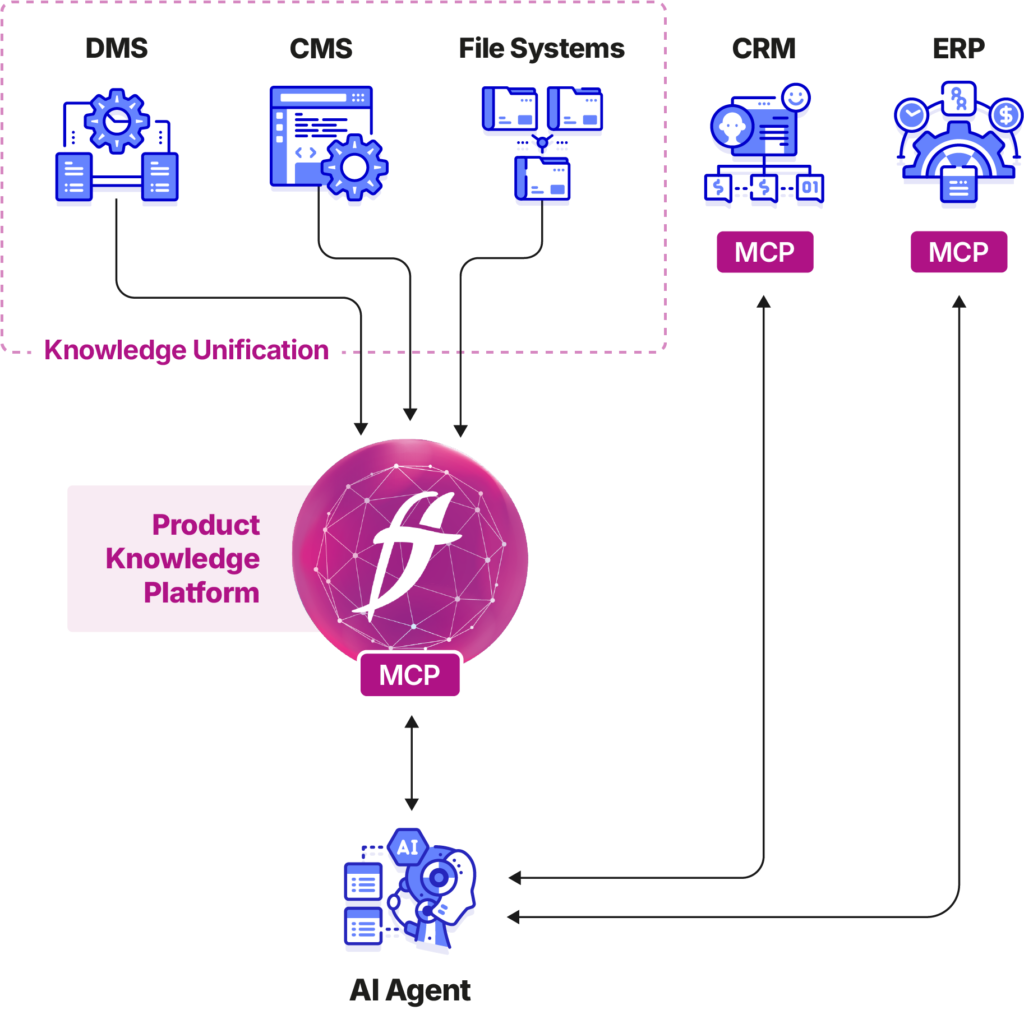
To provide AI agents with a single authoritative source of truth covering these fuzzy zones, the infrastructure must evolve. KM must adopt modern solutions that span and unify fragmented information for a given domain. They should function as MCP-enabled gateways, enriching content with structure and context, and enforcing access controls. Such solutions are now available, each specializing in different flavors of knowledge (e.g., legal, marketing, product).
The Product Knowledge Case
Product Knowledge is highly heterogeneous and dispersed across the enterprise, yet critically needed for all customer-facing activities. Platforms like Fluid Topics consolidate and centralize this knowledge and enable it for AI.
Takeaways
Agentic AI is redefining the purpose of knowledge management. The user is no longer a human, but an ecosystem of software agents serving or acting on behalf of people. Organizations that structure their knowledge for AI will tap into unprecedented levels of efficiency and productivity. Those who don’t will experience strong AI limitations. KM now has the opportunity and responsibility to lay a strong foundation for AI and for its own future.
The 2026 State of Knowledge Management & AI
AI alone isn’t enough: organizations must make their knowledge AI-ready. Learn the steps leading organizations are taking to close the gap.
 5 Knowledge Management Trends Defining 2026