

Industry Insights
5 Knowledge Management Trends Defining 2026
2026 knowledge management trends will be driven by AI innovation, shifting workforces, and evolving requirements for knowledge management systems. Discover the five KM trends that will define how enterprises capture, manage, and share knowledge in 2026.

How are leading organizations preparing for the next evolution in knowledge management (KM)? The KM landscape is undergoing its most significant transformation in decades. Organizations that once treated KM as an IT function or documentation project are now recognizing it as a strategic imperative that directly impacts their bottom line, innovation capacity, and ability to retain critical expertise.
Changes in 2026 will be driven by advances in AI technology, evolving workforce dynamics, and new requirements for knowledge management systems (KMS). Companies that fail to adapt risk missing out on lucrative business opportunities and losing critical institutional knowledge.
Discover the five knowledge management trends that will define how enterprises capture, manage, and share knowledge in 2026.
1. Preparing Knowledge Systems for the Age of AI
After the initial surge of AI solutions in 2024, organizations are turning their attention to building robust knowledge management systems that can sustain AI adoption. While companies continue to launch new AI projects this year, Gartner predicts that businesses will discontinue 60% of AI initiatives by the end of 2026 due to a lack of AI-ready data. Studies also indicate that poorly structured knowledge foundations are behind stalled AI projects. Therefore, one core challenge is adapting existing and future knowledge content so AI applications can access and understand the information.
First, this requires standardized terminology, consistent metadata and taxonomies, and a richer semantic context. This content enrichment allows AI systems to reliably interpret knowledge, connect related information, and deliver relevant responses when needed. Furthermore, AI can’t make assumptions or elaborate on information with knowledge gaps. To solve this, knowledge teams must analyze the AI-readiness of their content and refresh their content architecture and strategy, possibly in collaboration with Information Architects. Together, these content enhancements will improve AI decision-making and operational efficiency.
Beyond the quality and structure of content, KM systems matter when AI is concerned. Part of the existing content is properly stored in systems of record, which are reliable, identifiable reference sources of structured information for AI, such as CRMs for customer information or ERPs for financial data. However, most content remains siloed and scattered across the enterprise knowledge ecosystem in file systems that are hardly usable for AI.
To provide AI with a clear, authoritative source of information, knowledge teams must adopt modern solutions that unify fragmented content for each knowledge domain and restructure unstructured content for AI-fitness. Such platforms emerged in 2025 as smart AI-gateways, and they will help organizations fully realize returns on their AI technology investments.
2. Proving that Knowledge is Trustworthy
Adopting new AI tools will force teams to address questions and concerns around knowledge governance, validation, and provenance. AI-generated responses call into question whether users can trust what AI says is true. This is particularly important since 54% of people report being wary about trusting AI systems, according to a 2025 KPMG study.
To tackle this issue, companies need to demonstrate provenance for each AI output. This means providing transparent information about the AI model used and its outputs. It is also about ensuring that knowledge is governed, validated, and traceable from its source to its point of use.
- What is the origin of AI-generated knowledge? What data or content is used to construct this response?
- What is the history of the knowledge documentation used in each AI response? How has that knowledge changed, going from the source documentation to the final output?
- Is the AI output valid? Who approved it?
Furthermore, governance policies are needed to improve visibility and traceability. This means configuring and documenting prompts, context settings, available knowledge sources, RAG configurations, and more. It is crucial that employees, customers, and even AI systems understand which knowledge sources can be trusted (and why).
3. Human-In-The-Loop: A Non-Negotiable for AI Systems
Even as AI grows more sophisticated, it is not infallible. Errors, biases, and gaps in AI understanding can lead to misinformation or flawed decision-making. That’s why human-in-the-loop (HITL) approaches are becoming a standard requirement for any AI scenario.
AI handles scale, speed, and pattern recognition; humans provide judgment, context, and strategic direction. As AI adoption expands, human reasoning and skill will remain essential to knowledge management. The key is to balance AI’s efficiency with the human capacity for intentional, consistent, and empathetic interactions.
For this reason, human oversight will continue to govern three critical knowledge processes:
1) Authoring knowledge content
- Authoring the original source material and verifying that AI-generated content accurately reflects the intended meaning.
- Enriching formal knowledge with tacit knowledge.
2) Verifying the quality of AI outputs
- Testing AI-created onboarding sequences or walkthroughs to make sure they actually support new users.
- Checking AI outputs for content gaps and adding context as needed.
3) Validating compliance and governance with a HITL
- Making judgment calls, approving final answers, and determining ethical or compliance decisions.
- Validating that knowledge documentation passes content governance, brand standards, and regulatory requirements checks before publication.
AI-Augmented Support & Service Teams
Some support tickets and service requests consist of ambiguous or complex questions. AI systems analyze these requests and generate response drafts by retrieving relevant content from knowledge repositories. The AI-generated response is not sent automatically. Instead, the technician or agent must review the AI’s suggested answer, verify its accuracy and appropriateness, and, either approve, modify, or replace it before sending.
This human-in-the-loop workflow ensures that while AI accelerates response drafting, human judgment validates each answer. By maintaining this validation layer, organizations prevent misapplied solutions, responses that ignore customer context, guidance that contradicts current procedures, and communications lacking necessary empathy or clarity for sensitive situations.
Furthermore, transparency standards and feedback mechanisms will become more important. For example, companies will need to clearly tell users when they are interacting with AI-generated vs. human-validated knowledge.
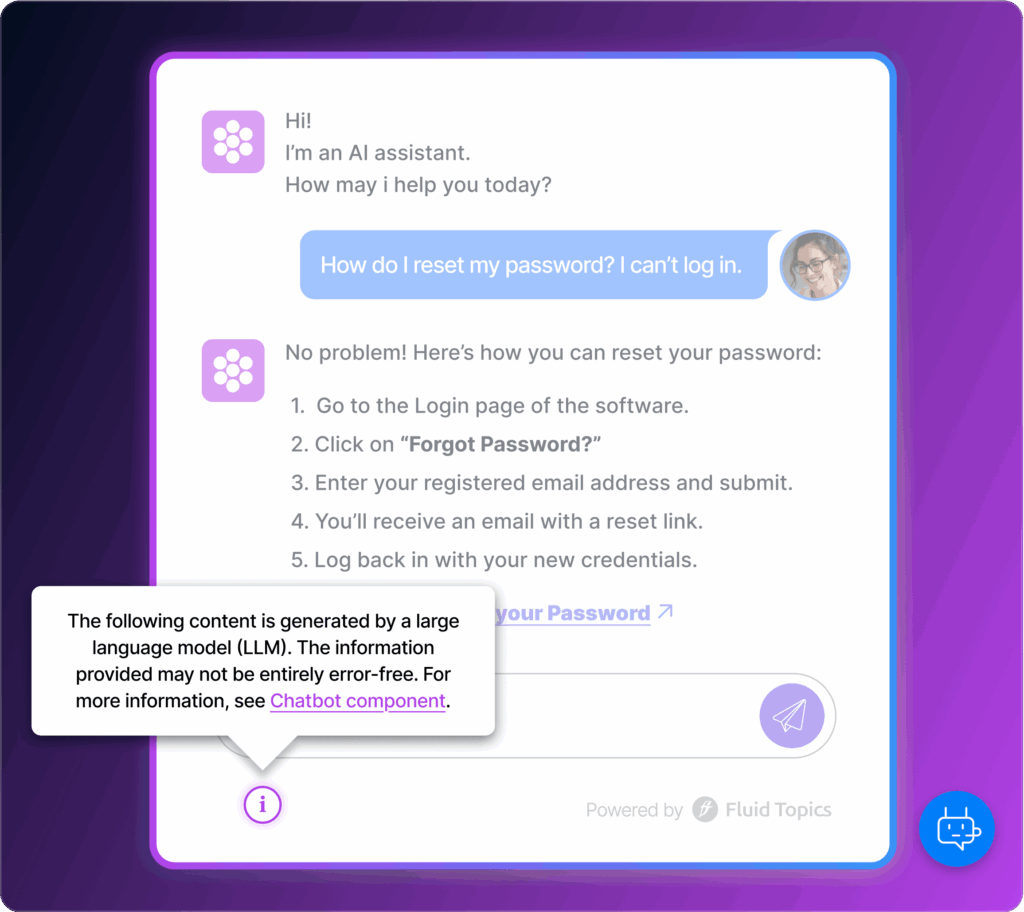
As these requirements advance, knowledge managers will step into expanded roles guiding AI strategy within knowledge operations. Beyond traditional content stewardship, they will define usage guidelines, establish standards for structure and quality, set rules for human oversight, and ensure AI systems operate in alignment with organizational objectives, risk frameworks, and compliance obligations. Zooming out to a company-wide view, knowledge managers also need to build an organizational knowledge culture. This includes encouraging knowledge sharing, coaching teams, and setting incentives.
4. Capturing Tacit and Implicit Knowledge
While the concept of capturing tacit and implicit knowledge is not new, AI raises the stakes. AI can only scale explicit information. Without capturing tacit and implicit knowledge, AI systems amplify existing knowledge gaps, leading to oversimplified outputs and incorrect assumptions.
Beyond addressing AI system requirements, capturing tacit and implicit knowledge will dampen the growing risk of knowledge loss. Veteran employees are retiring, hybrid work reduces informal knowledge transfer, and competitive job markets accelerate employee turnover. The solution lies in systematically capturing the valuable insights that live in experts’ minds.
To preserve it, companies must move beyond documentation alone and focus on supporting knowledge exchange with the right tools and processes. Successful strategies require both infrastructure and action:
- Workplace knowledge sharing: Establish communities of practice, internal forums, and collaborative spaces. These are places where people of all expertise levels come together to share knowledge freely.
- Knowledge networks: Connect internal teams directly with experts and not just content. These interactions facilitate knowledge transfer and provoke valuable questions and discussions that AI can document.
- Technology enablement: Invest in tools that support collaboration. This includes AI knowledge documenting tools, internal communication tools like Slack and Notion, and Product Knowledge Platforms like Fluid Topics.
- Cultural transformation: Create a work culture where employees value teamwork and sharing learnings. Teams can build this into performance expectations and rewards to drive transformation.
The payoff is substantial. Organizations that capture institutional knowledge before it disappears will gain a competitive advantage, reduce training time for new hires, and build resilience against workforce changes.
5. Measuring Knowledge Management’s ROI
Gone are the days when KM success was measured by the number of documents in your repository. In 2026, organizations are demanding concrete proof that their knowledge initiatives deliver measurable business value. The key is to choose analytics that clearly illustrate how knowledge contributes to tangible ROI and affects business goals. These goals include revenue, customer satisfaction, employee retention, and more.
- Time to resolve issues: Track how quickly your teams close support tickets, resolve customer issues, or address internal requests. Slower resolution times often signal that employees can’t find the right information quickly enough, or that existing documentation lacks clarity. This metric directly ties knowledge accessibility to productivity.
- Repeat error rate: High rates indicate that knowledge capture isn’t effective, solutions aren’t clear, documentation doesn’t address root causes, or knowledge isn’t shared. This metric identifies where processes are breaking down and which documentation or training needs improvement. Related metric: reduction in operational errors.
- Time to proficiency (TTP): This is the time it takes for a new employee to perform their role independently. Extended onboarding periods often indicate problems with content discoverability, search functionality, or outdated information. Reducing time to proficiency not only accelerates productivity but also cuts training costs significantly. Related metric: reduction in training costs.
- Knowledge helpfulness ratings: Views and downloads don’t tell the whole story. What matters is whether the information actually solves problems. Collecting direct feedback on content usefulness alongside related metrics like customer satisfaction (CSAT) and Net Promoter Score (NPS) reveals whether your knowledge base is truly serving its purpose.
- Knowledge retention for critical roles: To track tacit knowledge, teams should measure the percentage of identified critical knowledge that is documented or otherwise transferable. This is particularly important for mission-critical processes and high-risk decisions.
8 Knowledge Management Metrics to Track for Business Success
Stay Up to Date on Knowledge Management Trends
We expect these five trends to dominate headlines in the knowledge management world this year as companies continue to launch and refine AI projects. The quality of AI outputs is determined by the quality of the content feeding the model, so these projects are intrinsically linked to knowledge workflows, systems, and strategies. Still, 80% of all AI projects don’t make it past pilot stages. The 20% of successful projects will come from organizations that embrace these trends — preparing AI-ready knowledge foundations, integrating human validation workflows, implementing knowledge capture processes, and ensuring trustworthy AI outputs.
New technologies and tools are driving change, and companies need to keep up to transform and reinforce their knowledge systems. Thriving teams won’t necessarily adopt every tool at once. Rather, they will be strategic in their selection based on organizational goals, personnel trends, and digital readiness.
Knowledge management teams can subscribe to our newsletter to stay up to date on evolutions in the trends that impact their daily work.
Schedule a free demo of Fluid Topics with a product expert