 5 Knowledge Management Trends Defining 2026
Content Ops
What is Knowledge Management and Why Does it Matter?
Discover everything you need to improve your organization’s knowledge management. Define knowledge management, explore the stakeholders and steps involved, and outline the benefits and challenges. Finally, learn which metrics you need to measure knowledge management.

Table of Contents
- What is the Definition of Knowledge Management?
- What is a Knowledge Management System?
- What are the Key Components of Knowledge Management?
- Types of Knowledge in Organizations
- Explicit Knowledge
- Tacit Knowledge
- Implicit Knowledge
- The Knowledge Management Process
- Benefits of Having an Enterprise Knowledge Management System
- Improved Decision-Making
- Increased Efficiency and Productivity
- Customer Self-Service
- Faster Onboarding and Autonomy
- Fewer Errors
- How to Measure the ROI of Knowledge Management
- Challenges in Knowledge Management Systems
- Keeping Information Up-to-Date
- Overcoming Technological Barriers
- Getting Employee Buy-In
- Making Knowledge Easy to Find
- Preparing Knowledge Systems for AI
- Knowledge Management Systems vs.Product Knowledge Platforms
- How Do Product Knowledge Platforms Enhance Knowledge Delivery?
- Final Thoughts on Knowledge Management
Editor’s Note: This post was originally published in August 2024. It has been completely edited and updated for accuracy and comprehensiveness.
Key insights
- Knowledge management is the process of organizing, capturing, and sharing organizational knowledge so employees and customers can find and use information efficiently.
- Effective knowledge management combines people, processes, governance, technology, and content to improve decision-making and business performance.
- Modern knowledge management systems use AI to improve discovery, recommendations, and self-service experiences.
- AI-ready knowledge requires structured, well-governed, metadata-rich content that humans and AI systems can understand and reuse.
Creating, distributing, and using information effectively is what keeps an organization running smoothly. 58% of employers agree, stating that knowledge and information rank as critical business assets. When the right knowledge isn’t accessible for every team, customer, and partner, companies risk excess costs and low productivity in both the short and long term.
This blog offers a complete breakdown of the core topics within knowledge management. Read on to learn the following:
- Which teams and tools are needed for different knowledge management processes.
- The core benefits of good knowledge management practices, including increased efficiency, better self-service, and faster onboarding.
- How to overcome common knowledge challenges like keeping information updated and preparing knowledge systems for AI.
- How to measure the ROI of knowledge management.
- What the difference is between knowledge management systems and Product Knowledge Platforms, and which one better fits the needs of your organization.
What is the Definition of Knowledge Management?
Knowledge management is the process of finding, producing, organizing, and sharing information within an organization. Most often, knowledge refers to collective insights, tools, and processes that help employees and customers interact with the company’s products and services more efficiently.
Knowledge is organized in and distributed via various types of documents, videos, and visuals. This includes customer support tickets, technical documentation, training materials, employee handbooks, legal policies, FAQs, product comparisons, and more. There is also a lot of knowledge that companies can harness from firsthand employee experience. However, finding a way to extract and record this knowledge may be a challenge.
The State of Knowledge Management & AI
AI alone isn’t enough; organizations must make their knowledge AI-ready. Learn the steps these leading organizations are taking to close the gap.
What is a Knowledge Management System?
A knowledge management system (KMS) is a digital IT platform that contains and manages knowledge within a company. It offers information retrieval, organization, and sharing capabilities to enhance organizational performance.
Businesses can support the creation of a KMS by establishing a knowledge base, which is a centralized platform or digital library where information is easy to access. Modern knowledge management systems often include features such as searchable knowledge bases, document repositories, collaboration tools, and AI-powered recommendations.

91% of people say they would use an online knowledge base if it were available and met their needs.
Source: Zendesk
What are the Key Components of Knowledge Management?
Knowledge management comprises people, processes, strategy, content and information, and governance. Each element works together to help businesses produce knowledge, optimize processes, and achieve organizational results. Companies that implement these components see the benefits: improved employee expertise, enhanced productivity, reduced time to make decisions, better problem-solving, improved customer service, and more.
Knowledge management spans several teams that produce different types of internal and external company knowledge, from HR to legal, customer support, product, and IT teams. To understand how these components play out across different knowledge sectors, let’s zoom in on the product knowledge lifecycle.
What is Product Knowledge?
Product knowledge is the understanding one has about a product, including its specifications, features, uses, benefits, and troubleshooting information. Product knowledge helps someone explain what a product does, how it works, and why it adds value for users.
When producing product knowledge content, technical writers work closely with subject matter experts to develop detailed documentation. Similarly, product teams create product guides and charts, and engineers compile release notes that contain valuable information. Each team uses various tools to produce its content, including MS Word, CCMSs, CMSs, and GitHub.
Once teams have created product documentation, they need to publish and deliver the documents for easy findability. They must make the content available to employees and customers via relevant applications such as a unified knowledge base or documentation portal with advanced search engines to optimize knowledge discovery.
While Google achieves 95% first-page accuracy, most internal enterprise search engines have only a 10% first-attempt success rate. That’s a 9.5x performance gap.
Source: Slite
Then, just because the content is accessible doesn’t mean the job is done. From new offers to product changes and best practices, existing information needs continuous updates. In addition to regular content maintenance and governance, companies can implement feedback opportunities. Direct user feedback helps writers better understand which documents are the most helpful. Both this and feedback from the customer support team are highly useful insights that help knowledge content creation teams optimize their outputs.
Types of Knowledge in Organizations
Within knowledge management, there are various types of knowledge and information to collect and share. Each variety is important to the success of a company.
Explicit Knowledge
Explicit knowledge, or expressive knowledge, is tangible, recordable information that can be shared between people. It is easy to document, store, organize, and comprehend. It includes the information written down and published in documents such as product manuals, business reports, guides, studies, and more. Basically, it’s the content we imagine finding inside a knowledge base. This kind of knowledge is essential for training employees, providing self-service solutions to customers, and retaining knowledge within a company.
Tacit Knowledge
Tacit knowledge refers to learned knowledge that people gain through experiential learning when they apply theoretical, explicit knowledge to real life. This kind of intuitive understanding is difficult to put into words, making it challenging to formalize and document this kind of information. This includes knowledge such as the art of the sale, troubleshooting intuition during maintenance operations, and recognizing patterns to prevent customers from churning.
Implicit Knowledge
Implicit knowledge refers to the practical “know-how” individuals develop through hands-on experience and daily work. While it is closely related to tacit knowledge, implicit knowledge is generally easier to articulate, capture, and document within an organization. This type of knowledge is often formed during operational processes and reflects how tasks are actually performed in real-world scenarios. It includes the mental shortcuts, techniques, and personal methods employees use to complete work efficiently, often differing from formally documented procedures such as standard operating procedures.
The Knowledge Management Process
Each step of a successful knowledge management process comes with its own considerations. Businesses must determine the tools, processes, and people needed during all four stages of the knowledge processes.
Step 1: Identifying and Finding Knowledge
Knowledge exists across every part of a company. Before that knowledge is documented, knowledge managers must identify where to gather information from. You can do this by brainstorming and asking what kind of information would be useful for employees, partners, and customers. Then, you need to investigate whether this knowledge is already documented or if it’s solely in the minds of subject matter experts and operational team members.
Step 2: Knowledge Creation
The next step in enhancing a company’s knowledge management is to produce knowledge content. You need to source the valuable information identified by relevant teams (i.e., from product, legal, customer support, etc.). This can be done either by compiling documents, by asking teams to write initial content drafts, or by conducting expert interviews, leading project debriefs and launching surveys. Using this information, knowledge managers and technical writers will write new documentation.
Step 3: Knowledge Storage
To ensure that these documents are readily available, findable, and properly stored, companies need a centralized knowledge repository. That means your knowledge management solution should gather every file of your knowledge documentation and prepare it for distribution. To create a unified knowledge center available for any authorized users, your solution must be able to gather content in any format. Otherwise, the information will remain fragmented across multiple tools.
Step 4: Knowledge Sharing
Once your content is securely unified in a centralized knowledge base, you need to ensure users can access it from various endpoints and based on their permissions level. Sharing knowledge is essential for business success. All the hard work goes to waste if the knowledge isn’t shared with everyone who needs it and is able to be used when it matters.
Benefits of Having an Enterprise Knowledge Management System
From customer service to employee experience, here are some of the ways KMSs benefit organizations.
Improved Decision-Making
Knowledge management systems provide access to up-to-date, relevant knowledge for any given situation. As a result, both users and employees are able to make informed decisions about how to advance. A study by ResearchGate found that good knowledge management practices greatly improve an organization’s ability to make quick and effective decisions.
Increased Efficiency and Productivity
The longer it takes to get an answer, the harder it is for your users to be productive and the more frustration they may feel. With content accessible and easy to find in your knowledge management system, users can quickly and efficiently extract key information. They spend less time struggling to find the right documentation. Instead, they quickly troubleshoot issues before getting back to business as usual.
AI Knowledge systems lead to even higher results. 90% of knowledge workers who use AI are more likely to report higher levels of productivity than those who do not.
Source: Slack
Customer Self-Service
Combining an enterprise knowledge management strategy and a central knowledge base, users can easily find the important information they need to continue with their day. By finding answers autonomously, customers engage in self-service where they solve their own issues without needing to contact a support agent. In addition to improving customer satisfaction, self-service reduces the volume of support tickets, allowing agents to focus on more complex issues that require personalized assistance.
Modern AI chatbots have also emerged as great assets in knowledge management systems. Many companies are upgrading their knowledge hubs with AI chatbots to offer more interactive conversations with users, enhancing their experience.
Integrating our help content with a chatbot helped us achieve a 65% support deflection rate, saving time while empowering users to find answers on their own.
Sagar Garuda
Senior Director of Learning at Darwinbox
Faster Onboarding and Autonomy
New hires often have plenty of questions and must locate information fast and without friction. Knowledge systems hold essential resources and training content that enable employees to learn and work independently.
Fewer Errors
With well-defined processes, data, and metrics, people don’t have to guess. They can refer to documentation while completing tasks to confirm whether they’re following procedures and not overlooking critical steps.
How to Measure the ROI of Knowledge Management
Several key metrics help teams measure the success of their knowledge management efforts. Key knowledge analytics also provide insights into areas where teams can improve and optimize knowledge systems to maximize business results.
- Time to resolve issues: Monitor how fast your teams close support tickets, solve customer problems, or handle internal requests. Longer resolution times often indicate employees can’t locate the correct information quickly enough, or that current documentation isn’t clear. This measure directly links knowledge access to productivity.
- Repeat error rate: Elevated rates suggest that knowledge capture isn’t working well, solutions lack clarity, documentation fails to address underlying causes, or information isn’t being shared. This metric highlights where workflows are falling apart and which documentation or training should be strengthened. Related metric: decreased operational errors.
- Time to proficiency (TTP): This refers to how long it takes a new hire to carry out their job independently. Longer onboarding timelines often signal issues with content findability, search performance, or stale documentation. Shortening the time to proficiency not only speeds up productivity but also meaningfully reduces training expenses. Related metric: lower training costs.
- Knowledge helpfulness ratings: Content views and download counts don’t capture the full picture. The real measure is whether the content genuinely resolves issues. Gathering user feedback on how helpful your content is, along with connected metrics like customer satisfaction (CSAT) and Net Promoter Score (NPS), shows if your knowledge base is fulfilling its role.
- Knowledge retention for critical roles: To monitor knowledge development, teams should quantify the essential knowledge that is documented or made transferable in other ways. This is especially vital for mission-critical workflows and high-risk decisions.
Customers using Fluid Topics for product knowledge management have reported 50–75% reductions in search time. A leading supplier of analytical instruments saved an average of 800 hours of technician time each month, after adopting a dynamic content delivery approach.
Challenges in Knowledge Management Systems
Despite these benefits, there remain a few challenges that companies must overcome to achieve success.
Keeping Information Up-to-Date
Many companies face regular changes, from the quick pace of product launches to expansion into new countries. In the face of these shifts, keeping your knowledge up to date is difficult, especially given the sheer amount of knowledge. 85% of organizations report having over 1 million documents and files to manage, while 25% have over 25 million files. Despite this challenge, knowledge maintenance and updates are essential. Otherwise, employees and customers will be frustrated at best and experience product downtime at worst with inaccurate, out-of-date content.
Overcoming Technological Barriers
Teams must identify and eliminate any technical obstacles to creating a unified repository of product information. Many teams like to use their own tools and methods for documenting and storing information, and they don’t want to change. People will expect companies to find a common solution that easily integrates with various content sources and multiple applications or endpoints.
25% of respondents say their documentation is spread across multiple platforms. 37.3% say it’s mostly consolidated with some documentation on other sites. 36.6% say it’s all centralized.
Source: State of Docs
Getting Employee Buy-In
Getting teams to adopt new knowledge systems and processes requires an organizational culture change. This issue may stem from various missteps: a lack of leadership support, missing training materials, unclear communication, undocumented processes, and more. Yet, without employee buy-in, companies will not achieve their expected ROI.
Making Knowledge Easy to Find
Just because companies gather knowledge into a repository or portal doesn’t mean it’s easy to locate. Users must be able to quickly search and find relevant, up-to-date information, or else they will increase support tickets, ignore procedures, and make incorrect assumptions with varying levels of risk.
Preparing Knowledge Systems for AI
In 2025, AI tools and systems became more advanced and capable of reasoning. As a result, knowledge managers must now prepare AI-ready strategies so these systems can discover and understand knowledge. Alongside this rise, a fundamental shift is occurring: the primary consumer of enterprise knowledge is changing from humans to AI agents. To prepare knowledge content for AI, writers must ensure documentation is granular, metadata-rich, and semantically explicit with consistent terminology and cross-content links. These elements help enterprise knowledge be accurately indexed, retrieved, and interpreted by AI models.
2025 also gave rise to agentic AI. To be effectively leveraged by agentic systems, knowledge must be accessible through Model Context Protocol (MCP) enabled repositories. MCP accessibility ensures that AI agents can seamlessly query, navigate, and use knowledge across systems without friction. It also requires aligning content architecture with machine-readable standards so that context, relationships, and intent are preserved when consumed by AI models.
Knowledge Management Systems vs.
Product Knowledge Platforms
A KMS helps organizations make the most of their collective knowledge by offering tools to create, organize, and find important information easily. It often works with other systems to make sure that accessing and sharing information is smooth and efficient.
In comparison, a Product Knowledge Platform (PKP) is a software solution that collects product knowledge from across sources and in any format, unifies it in one central knowledge hub, and then delivers it across various channels. Its primary goal is to make information accessible and engaging for end-users, often by structuring and formatting content in a way that enhances usability and relevance.
PKPs are also an essential knowledge management layer for AI applications.
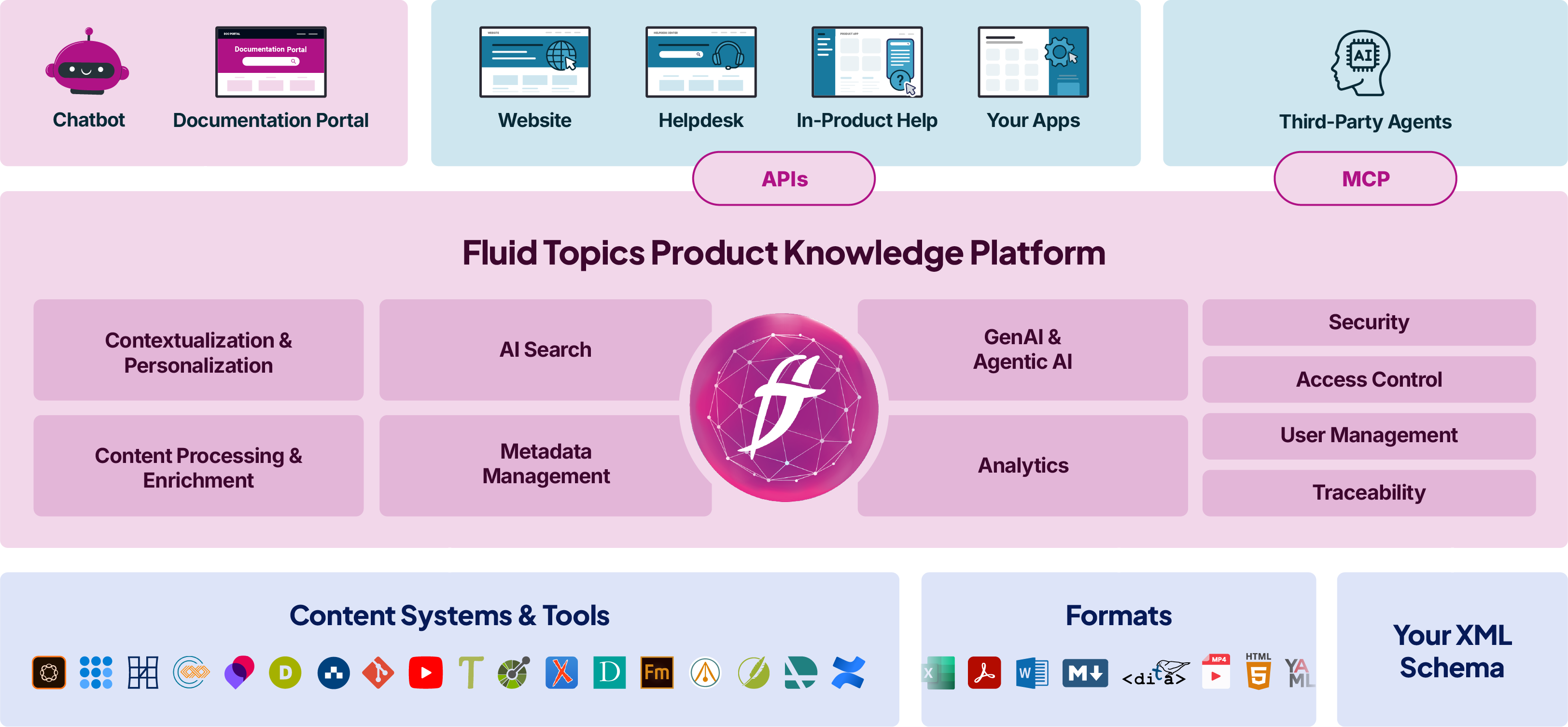
While knowledge management involves the creation of content to document knowledge from various people and teams, PKPs don’t offer content creation tools. They extend the collaborative process of content creation across the organization by integrating a wider range of content types, such as Microsoft Word documents or Markdown files provided by stakeholders external to the documentation team.
With respect to delivery, both systems have distinct trajectories for how content moves and is shared. While KMSs exchange information between parties, PKPs deliver information from companies to users, both internal and external.
Another difference is in who the content in these systems is for. Companies often use knowledge management systems to provide content to internal teams. Depending on their KMS structure, they may also share beneficial product knowledge with external users through a knowledge base or help desk. On the other hand, Product Knowledge Platforms deliver content to many users across touchpoints. Therefore, they require a strong user access management portal to define content access permissions for different types of user profiles.
It’s important to note that when choosing product knowledge tools and solutions, your choice isn’t either a PKP or a knowledge management system. They’re complementary! PKPs are efficient at providing accurate, helpful content from KMSs to end users on the devices and at the touchpoints of their choosing.
How Do Product Knowledge Platforms Enhance Knowledge Delivery?
You may think that a series of documents, collaboration tools, and a knowledge base are sufficient for your company’s knowledge management. But there are several ways that PKPs optimize and enhance content operations and delivery. Here’s how the leading Product Knowledge Platform, Fluid Topics, takes your knowledge content to the next level:
- Easy integration: Fluid Topics offers seamless integrations for all your content sources and tools, whether it’s a tech doc team’s CCMS or a marketer’s Word document, helping to break down content silos. By effortlessly connecting with your existing systems, Fluid Topics ensures that your knowledge base, content repositories, and other tools work together smoothly.
- Hybrid search: Fluid Topics combines the accuracy of keyword search with semantic search and natural language processing to create a hybrid AI search engine. It interprets intent, extracts meaning, and delivers personalized, highly relevant results for optimal knowledge findability.
- Content Freshness: CDPs help companies avoid outdated and inconsistent content. As soon as documentation is updated in an authoring tool connected to Fluid Topics, it is updated across touchpoints in a single click. Therefore, your documentation is always aligned with your product updates at any touchpoint.
- AI applications: The platform supports generative assistants, embedded copilots, and integration with agent frameworks. This allows product knowledge to power both internal and customer-facing AI experiences.
- Enrich knowledge for AI: Fluid Topics adds structure, context, and metadata to knowledge content, transforming it into information that AI tools and agents can understand. This enables accurate, meaningful results across embedded AI features and external agentic systems.
- MCP integration: Its integrated MCP server allows LLMs and AI agents to connect with the Fluid Topics Knowledge Hub, enabling relevant, context-aware access and interaction.
- Access right management: Fluid Topics allows teams to define and implement strict access rights to restrict human and AI access to authorized content only.
- Security and compliance: The platform uses strong security measures, including role-based access, single sign-on, and full audit logging, and is ISO 27001 certified to ensure data is protected at every stage.
Final Thoughts on Knowledge Management
Knowledge management is critical for companies of all sizes and across industries. The key is to centralize knowledge content into a unified repository. Here, the content is stored and later accessed through various endpoints for a cohesive content experience. To reap the many benefits of knowledge management, we recommend combining your KMS with a Product Knowledge Platform like Fluid Topics. Discover how to set up your user-friendly, AI-native knowledge base with Fluid Topics.
The 2026 State of Knowledge Management & AI
AI alone isn’t enough: organizations must make their knowledge AI-ready. Learn the steps leading organizations are taking to close the gap.
FAQs
There are several good candidates for building an AI-ready knowledge base depending on your needs. Fluid Topics is the leading software for building a knowledge base with native AI capabilities for technical and product knowledge. Other popular choices include Confluence (for Jira users), Document360 (for generic knowledge management), Slite (for remote teams), Zendesk (for customer support), and more.
5 Knowledge Management Trends Defining 2026