

Content Ops
What is a Content Delivery Platform? Definitions, Benefits & Key Features
A Content Delivery Platform (CDP) is a software solution that aggregates and unifies disparate information into a central knowledge hub and seamlessly delivers it across teams and customer touchpoints. Compare CDPs side-by-side with Component Content Management Systems to break down the difference between these tools. Then, learn more about the benefits and must-have features of a CDP, then explore Fluid Topics' offer.

Table of Contents
Editor’s note: This article was originally published in March 2024. It has been completely revised and updated to ensure accuracy and completeness.
From user enablement and product adoption to customer success, product knowledge has the power to achieve the most critical company goals.
But at the same time, delivering product content has never been more challenging. Organizations are turning to agile methods with ever-shorter release cycles, and new versions arriving every month, every week, or even every day.
According to a 2025 Slite survey, 1 in 5 employees lose over an hour a day searching through documentation and knowledge sources, struggling to find information. The last thing a business wants is unreliable, outdated, and unfindable product answers, leading to frustrated customers and increased support costs. This is where Content Delivery Platforms, or CDPs, come in.
In this post, we’ll define what a Content Delivery Platform is and how it differs from a Component Content Management System (CCMS). Then we’ll highlight the business benefits of a CDP and wrap up by outlining the key features to look for when choosing a content delivery solution.
What is a Content Delivery Platform?
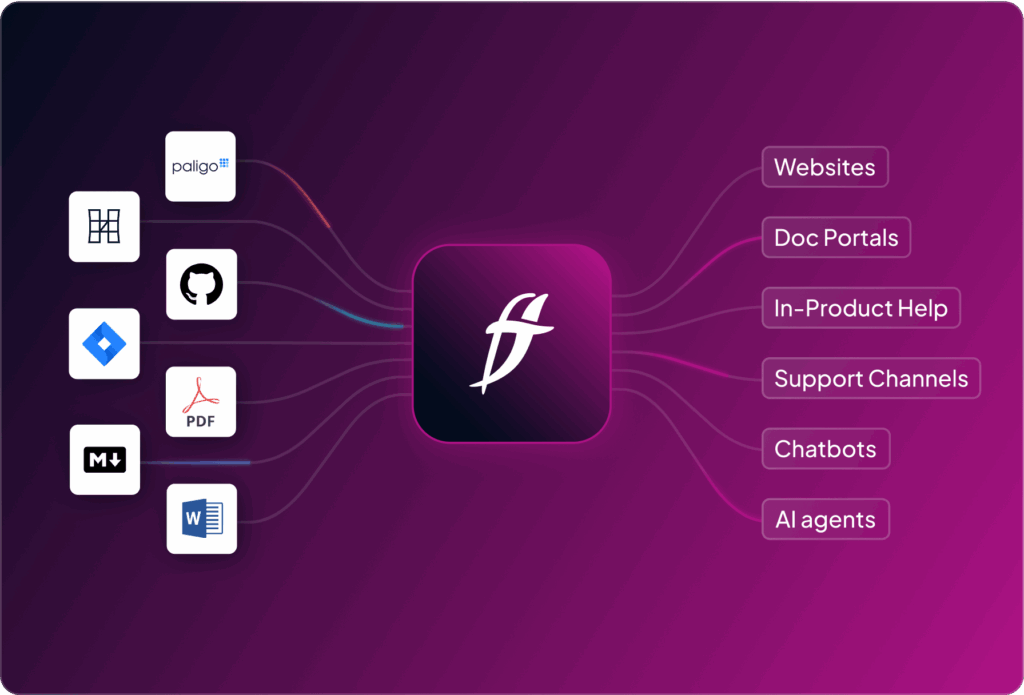
A Content Delivery Platform is a software solution that collects all your product knowledge from any source – content management systems (CMS), CCMS, GitHub, SharePoint, helpdesk tools, Wikis, – and in any format, including DITA, Markdown, YAML, PDF, HTML, Word. It then unifies it into a central knowledge hub and makes that content available to multiple endpoints via Application Programming Interfaces, or APIs.
CDPs work seamlessly with any authoring tool. They provide many standard and custom connectors, ranging from the most popular CCMSs and document processors to very specific in-house writing systems. As such, CDPs expand content creation and collaboration across the organization by including stakeholders outside the documentation team. Advanced CDPs handle both structured and unstructured content.
Popular Integrations with Fluid Topics to Enhance Your Content Workflow
What Does a Content Delivery Platform Do?
Top CDPs help companies carry out several actions:
- Provide omnichannel content publishing by aggregating content from multiple sources and authoring tools.
- Normalize different formats into a unified structure.
- Enrich content with metadata and taxonomies for better discoverability.
- Deliver content to any endpoint, including web portals, in-product interfaces, AI chatbots, AR/VR devices, and more.
- Update content automatically across all channels when source material changes.
- Enable Content-as-a-Service by offering contextualized and personalized content experiences to users via the device and touchpoint of their choice.
- And much more.
Integrating a Content Delivery Platform into content operations ensures consistency, reduces manual publishing work, and enables multi-channel content experiences.
The Ultimate Guide to Content Delivery Platforms
CDP vs. CCMS: What is the Difference?
While both a Content Delivery Platform and a Component Content Management System deal with managing and distributing content, they serve different purposes and target different stages of the content lifecycle.
A CCMS is a Content Management System that manages content at a component level rather than at the document level. Components can be words, paragraphs, series of paragraphs, images, videos, and more. Metadata tags provide additional information (e.g. the author, audience, product version,…) about the content itself and facilitate content management and searches. In CCMSs, content structure is standardized so the system can assemble and reuse the different components for different publications. As such, CCMSs enable collaborative and topic-based authoring, as well as higher content creation productivity.
It’s worth noting that CCMSs only handle and publish the content authored within the CCMS itself and exclude all other content (e.g., PDF datasheets produced by product managers or marketing documents created with MS Word).
These two solutions complement each other. Fluid Topics, as a leading CDP, integrates seamlessly with various CCMS and enterprise applications such as Paligo, Componize, Author-it, Heretto, and RWS’s Tridion Docs.
| Attributes | CCMS | CDP |
|---|---|---|
| Content Creation | Yes | No |
| Content Sources | Exclusively publishes content authored in the tool | Collects and publishes content from various sources and formats |
| Content Type |
Structured | Structured and unstructured |
| Applies document/ page templates | Depending on the delivery mode | Yes |
| Delivery mode | Documents, HTML pages, file exports | APIs and default web portal |
| Endpoints | Multiple – file export to different endpoints | Multiple – Through APIs |
| Fit for AR/VR, chatbots, or processes? | Non applicable | Yes |
| Allows for personalized content | Yes, at content creation | Yes, dynamically, at content delivery |
Who is a Content Delivery Platform For?
A CDP proves suitable for any organization across various industries, including software, manufacturing, high-tech and electronics, financial services, regulatory bodies, and healthcare. However, it is particularly useful for businesses that:
Manage large and complex knowledge bases: A Content Delivery Platform provides a centralized repository for all knowledge assets that otherwise would be stored over multiple systems, preventing many users from easily accessing them.
Have many different publishing formats: Organizations should allow their technical documentation and marketing teams to write content in their preferred tools. A CDP supports multiple formats and provides the same content experience across the board to all sources.
Need to update content frequently in multiple places: The accelerating velocity of product launches and frequent updates impact the productivity of information development teams and create new challenges. Through continuous content delivery, a CDP ensures content is always up-to-date across all channels.
Are looking to implement more personalization: Users expect contextually relevant, personalized, consistent content experiences. A CDP delivers knowledge to each user according to their profiles, preferences, and also to their behavior.
Are in highly regulated industries: In industries such as financial services, life sciences, pharmaceuticals, and legal, delivering non-compliant content comes with a hefty price tag. A CDP ensures that documentation meets regulatory and compliance standards.
What are the Benefits of a CDP?
Teams that invest in CDPs see real business value quickly. Some benefits organizations report include:
- Reduced publishing costs: Teams can publish once and distribute across all channels, minimizing manual formatting, duplicate workflows, and maintenance efforts while keeping content accurate and consistently up to date everywhere it appears.
- Reduced support costs and increased efficiency: CDPs offer self-service opportunities by delivering personalized, relevant content that helps users resolve issues independently. This reduces ticket volume and lowers support costs.
- Improved content findability: CDPs enrich technical content with metadata, taxonomies, and dynamic tagging, using automated classification and contextual linking. This, combined with advanced search engine technology, enhances findability and understanding.
- Better user experience and engagement: With a CDP, teams deliver context-sensitive information in an instant. This provides immediate support when users need it most, improving their experience and boosting product adoption.
Key Features of Modern CDP Solutions
As with any technology, choosing the right content delivery solution can be overwhelming. Expectations are higher than ever – customers want a tool that is cost-effective and seamlessly integrated into their existing IT landscape, with enterprise-grade security and scalability.
Finding a Content Delivery Platform that meets all these criteria is a challenge. Here are some feature guidelines for choosing the right CDP:
Integration with any content sources and tools
Leading CDPs should provide ready-to-use integrations for all your content sources and tools, such as a technical documentation team’s CCMS or a marketer’s Word document, and help overcome your content silos.
Generative AI capabilities
Modern CDPs must come equipped with native Generative AI (GenAI) capabilities to deliver truly personalized, context-aware experiences. Look for platforms that harness GenAI for conversational assistants, smart content summarization, automated translations, and intelligent code generation, seamlessly integrated across the entire customer journey.

Agentic AI
Agentic AI goes beyond basic content generation by autonomously planning and executing tasks to achieve defined goals. These systems perform best when they have access to a few authoritative knowledge sources, like a CDP for unified product knowledge. Top CDPs will include a Model Context Protocol (MCP) server, which allows AI agents to interact with the documentation in the CDP.
Out-of-the-box portal
CDPs are designed to feed content to any digital touchpoint. By default, they should provide a turnkey portal with key features. This includes permission-based content accessibility, advanced search capabilities, responsive readers, and multilingual user interfaces that deploy in minutes, not months.
Autonomous portal configuration
The CDP portal should be simple to configure through settings without requiring interventions from IT, vendor services, or system integrators. The portal should be customizable to an organization’s branding for a better user experience that meets current and future business needs.
Hybrid Search
Best-in-class CDPs should offer hybrid search capabilities to deliver fast and accurate. Hybrid search combines the precision of keyword-based search with the deeper understanding of semantic search, ensuring users can find relevant information whether they know exactly what they’re looking for or not.
Keyword vs Semantic Search: What You Need to Know
Interactive capabilities
Leading platforms offer interactive tools such as bookmarking, adding comments and notes, delivering feedback, and building personal books.
Native mobile experience
Field service teams need to be supported on the device they prefer, no matter what that device is. Whether it be a laptop, a tablet, a smartphone, or AR/VR goggles, CDPs should render text, graphics, 2D and 3D models, and multimedia content consistently and seamlessly.
Offline mode
Mobile and offline accessibility to content with a sync capacity for when connectivity is reestablished is crucial to serve customers.
SEO and GEO capabilities
An online documentation portal can generate organic traffic for companies if it is optimized for search engines like Google and Bing as well as LLMs like ChatGPT, Claude, and Gemini. Top CDPs should offer an option to activate and customize the way that content is crawled by search engines and AI bots.
Deep Analytics and Reporting
The best CDPs provide rich and valuable insights into how a company’s technical documentation and product content are performing. The platform should capture every user interaction with high levels of detail and deep context to drive content activity with meaningful information and offer better customer service.
Languages
Next-generation CDPs should ensure full support for global operations with the same speed, relevance, and cutting-edge Natural Language Processing capabilities for all languages. Teams should check that their CDP both supports multi-lingual content and provides user interfaces in the languages that their users need.
Why do Companies Choose Fluid Topics for Content Delivery?
Fluid Topics is a full-fledged AI-powered Content Delivery Platform that ingests and unifies all your product information – from manuals to API docs to support articles – no matter the initial source and format. Our solution then delivers the most relevant and personalized content to any digital channel, device, and application, in context with the users’ needs and environment.
As a SaaS solution, the Fluid Topic Platform is designed to integrate with your existing infrastructure and tools to enable dynamic publishing without disrupting the company’s writing process.
Our platform is a game-changing solution for technical documentation publishing teams, and it can prove revolutionary for many other teams, such as customer support and field service teams, too.
Our solution is currently used by leading global enterprises like Siemens Building Technologies, Liebherr Mining, Kone, Johnson Controls International, JFrog, Hexagon, Teradata, and Precisely.
Customers have seen great results with Fluid Topics:
- 50,000 monthly views on the help portal and a 65% support ticket deflection rate (Source: Darwinbox)
- 25 documentation portals deployed in record time (Source: Johnson Controls International)
- 34% decrease in support tickets (Source: swissQprint)
- 2 weeks saved in the documentation delivery process (Source: Hexagon)
- 5 million visits on the portal within the first year (Source: Teradata)
Sagar Garuda, Senior Director of Learning at Darwinbox, said, “Thanks to Fluid Topics and Paligo, content creation and distribution for Darwinbox have become a breeze!”
Aurélien Unfer, Project Manager New Information and Communication Technologies at Liebherr Mining, said “Fluid Topics’ Content Delivery Platform provided us with a fully-featured solution that required limited customization to match our needs. The implementation of the platform is an important modernization step that will help remove inefficiencies as well as allow more personalized forms of documentation and up-to-date instructions.”
The right CDP can help overcome the challenges that can otherwise swamp tech doc teams while improving the end-user experience for a clear business win.
If you’d like to explore what our Content Delivery Platform can do for your business, get in touch with our team.
Schedule a free demo of Fluid Topics with a product expert
Frequently Asked Questions (FAQ)
Yes, CDPs and CCMSs complement each other. A CCMS handles content creation and component-level management, while a CDP aggregates that content along with other sources, maintains and enriches content metadata, and handles omnichannel delivery.