
 How to Make Your Documentation AI-Ready: A Practical Step-by-Step Guide
AI
Top 10 Questions About Agentic AI Answered
AI innovations are emerging faster than ever. The speed of advancement is leaving many people wondering how to stay up to date on foundational concepts. Discover the top questions about agentic AI so you can get to work and use AI tools with confidence.

Table of Contents
- 1. What Is Agentic AI?
- 2. What Are AI Agents?
- 3. What Is MCP, and Why Is It Important?
- 4. How Is Agentic AI Different from Generative AI?
- 5. Why Does Agentic AI Matter for Technical Documentation?
- 6. Will Agentic AI Replace Technical Writers?
- 7. What Kind of Risks Can Arise With Agentic AI?
- 8. Do Companies See Concrete ROI from Agentic AI Implementation?
- 9. How Can Companies Prepare for Agentic AI?
- 10. What Does the Future of Agentic AI Look Like?
- Conclusion
What you’ll learn:
- What agentic AI is, how agents work, and how these AI systems are different from generative AI tools.
- Why agentic AI is important for technical documentation workflows, how the role of tech writers will change, and why AI won’t replace technical writers.
- How companies can prepare for agentic AI projects and the kind of results that real organizations are seeing.
With new evolutions of AI technology being released at record speeds, it’s only normal that at some point you may feel like you missed a key piece of information. And you’re certainly not the only one feeling that way! While 94% of companies are pushing for more AI, 70% of the companies have trained less than 1 in 4 of their workforces on AI tools. To help get you up to speed, we’ve identified the top agentic AI questions. By the end, you’ll be ready to work on new AI projects with confidence.
1. What Is Agentic AI?
Agentic AI refers to AI systems that can autonomously pursue goals, make decisions, and take actions with limited human supervision. Agentic systems orchestrate AI agents — specialized AI models that replicate human decision-making — to communicate with databases and applications. They make independent decisions and execute various sub-tasks to achieve pre-defined goals.
Half of all companies and 54% of top performers identify AI as a priority investment area.
(McKinsey)
2. What Are AI Agents?
An AI agent is a software system that can be used to interact with different environments, collect data, and perform tasks to meet a larger goal. Larger agentic systems orchestrate multiple agents to execute actions with available tools and systems.
67% are considering autonomous agents as part of their AI transformation.
(BCG)
3. What Is MCP, and Why Is It Important?
MCP stands for Model Context Protocol, and it is an open standard that allows AI systems to query (both read and write) enterprise applications, tools, and databases. It’s comparable to a USB standard for AI integrations: one consistent method for connecting to many different applications and services.
Systems enabled with MCP servers allow AI agents to securely access databases, call APIs, and trigger workflows. This creates interoperability between AI agents and business systems. As agentic AI grows, MCP architectures will become essential infrastructure for business applications.
4. How Is Agentic AI Different from Generative AI?
Generative AI and agentic AI differ in objectives, how they work, the level of autonomy given to each system, their core capabilities, and how they influence the roles of humans.
Generative AI creates content such as text, images, audio, and code by mimicking human creativity. It is powered by large language models (LLMs) trained on large datasets to understand context and generate responses or outputs from prompts. Rather than waiting for direct prompts, agentic AI systems work independently and can plan and act autonomously to achieve goals with minimal human supervision.
Capability
Generative AI
Agentic AI
Core objective
Creates human-like content (text, images, code).
Achieves goals and executes workflows by planning, reasoning, acting, and coordinating across applications.
Operational trigger
Requires manual, continuous prompting to produce outputs.
Operates autonomously, acting and adjusting as necessary based on high-level goals.
System autonomy
Reactive; responds to direct inputs.
Active; plans, self-corrects, and takes action.
What this looks like in practice:
The Generative workflow: A user prompts an AI assistant to draft a support ticket response. The AI replies with a text matching the user request. The user must then manually copy and paste the AI output into an email to send it to the customer.
The Agentic workflow: The agentic system autonomously detects an incoming support ticket. It then retrieves relevant product specs, verifies the technical accuracy against internal documentation, updates the CRM, and sends the resolved response directly to the user, without requiring human intervention.
5. Why Does Agentic AI Matter for Technical Documentation?
As AI systems increasingly retrieve, interpret, and execute information on behalf of users, AI agents are becoming active consumers of technical content. This changes the role of documentation. Content must now be optimized for both human readability and for machine understanding, structured retrieval, and automated workflows.
Agentic AI also offers valuable use cases for documentation teams to accelerate publication cycles, improve productivity, and streamline operations. Agentic systems help tech writers by automating key tasks:
- Detect API or code changes and update related documentation,
- Create and manage content tickets,
- Manage user feedback loops to optimize documentation,
- Monitor content accuracy and suggest updates.
Learn how to build a trusted knowledge layer for Agentic AI.
6. Will Agentic AI Replace Technical Writers?
No, AI will not replace technical writers, but it will significantly change their roles. Writers are evolving from content creators into Knowledge Architects and AI Content Strategists. These roles go well beyond drafting, revising, and other traditional content work. Their new responsibilities increasingly include:
- Structuring information for AI retrieval
- Maintaining content quality and governance
- Designing reusable knowledge models
- Testing AI-generated responses
- Managing trust and accuracy
The emphasis shifts from writing individual documents to managing intelligent knowledge ecosystems.
Executives see talent and AI as complementary with 64% saying AI and humans will work side by side.
(BCG)
7. What Kind of Risks Can Arise With Agentic AI?
The main risks of agentic AI include lack of source transparency, unauthorized actions, security vulnerabilities, poor governance, and outdated or low-quality training content. Trust, verification, and oversight become critical since agentic systems act autonomously to complete goals.
When agentic AI makes decisions based on faulty information, the consequences may be much worse than a simple hallucination. Therefore, agentic systems need to be built on a solid knowledge foundation with an MCP-enabled knowledge layer to make all relevant information accessible to agentic workflows.
Furthermore, teams must implement robust cybersecurity measures. This is a common issue, with 76% of companies admitting that their AI cybersecurity measures need further improvements.
With strong governance frameworks and reliable content foundations in place, teams can trust agentic AI to perform workflows with minimal human supervision.
91% of US CIOs and 85% of global CIOs say explainability or traceability gaps have already delayed or stopped AI from reaching production.
(Dataiku)
8. Do Companies See Concrete ROI from Agentic AI Implementation?
The top-performing companies are seeing strong ROI from agentic AI projects. Implementing AI in everyday workflows leads to gains of 10% to 20% productivity potential. Yes, only about 25% of companies are reporting significant results. The divide comes from companies that have a clear content strategy, invest in the right tools, and measure relevant metrics.
AI implementation delivers consistent productivity gains ranging from 10% to 45%, with a particularly strong impact on technical, support, and creative tasks.
(Stanford)
9. How Can Companies Prepare for Agentic AI?
Companies should start to prepare for agentic AI by improving their content operations and knowledge infrastructure. Key steps include:
- Structuring content consistently
- Improving metadata quality
- Eliminating redundant information
- Building centralized knowledge repositories
- Implementing governance and validation processes
- Making content accessible through APIs and AI-ready architectures
Preparation is less about buying new AI tools and more about fixing fragmented knowledge systems.
10. What Does the Future of Agentic AI Look Like?
Agentic AI is expected to become deeply integrated into enterprise workflows, customer support, technical documentation, and digital experiences. Soon, users may interact less with static documentation and more with intelligent agents that dynamically assemble, personalize, and deliver information or execute tasks. For tech writers, this represents a major shift: documentation will no longer simply inform users. It will actively power AI-driven actions.
Conclusion
The AI landscape is shifting, leading to new trends driving the future of technical documentation. Staying aware of key concepts and the latest industry changes will help you stay resilient, so you have the skills and knowledge necessary to adapt and grow.
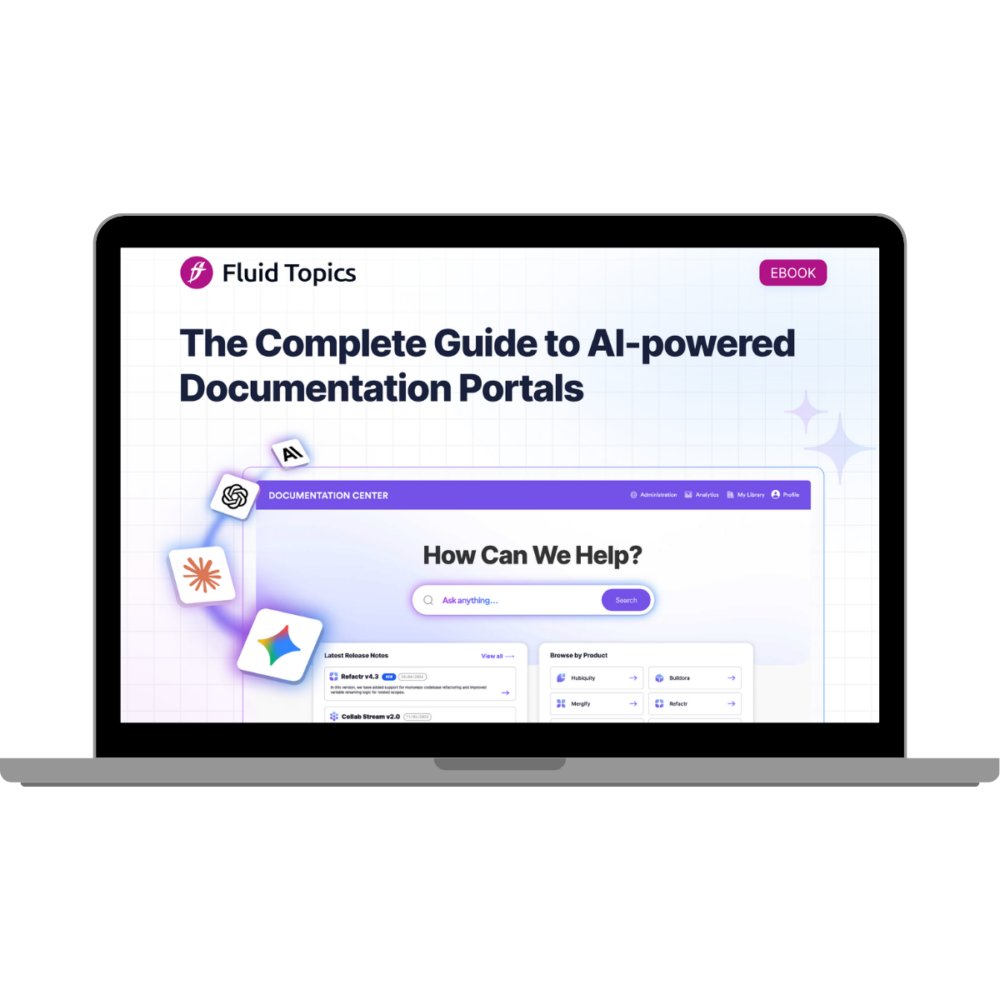
To learn more about how AI is changing technical writing and, more specifically, documentation portals, get your copy of our new eBook: The Complete Guide to AI-Powered Documentation Portals.
The Complete Guide to AI-Powered Documentation Portals
Turn your documentation into a system that delivers instant answers.
 How to Make Your Documentation AI-Ready: A Practical Step-by-Step Guide

