
 Your AI Chatbot Is Only as Good as Your Documentation
Content Ops
What is Content Operations and Why is it Important?
Dive into the world of content operations: what are they, what benefits do they bring, and what elements are key for efficient content ops?

Table of Contents
- What is Content Operations?
- What is the Role of Content Ops in Content Management and Strategy?
- What’s the Role of a Content Operations Manager?
- What Components Does Content Operations Include?
- People
- Processes
- Technology & Tools
- Analytics
- What are Common Content Operations Challenges?
- Managing Multiple Formats and Platforms
- Scaling Documentation for Agile Development Cycles
- Ensuring Content Relevance and Freshness
- Maintaining Content Governance
- Preparing Content for AI
- What are the Benefits of Efficient Content Operations?
- What Do You Need for Effective Content Operations?
- Implement a Consistent Content Strategy
- Elaborate a Content Reuse Strategy
- Create a Centralized Content Repository
- Leverage the Right Tools
- Optimize Content for AI Understanding
- Embrace Cross-Functional Collaboration
- Uphold Strong Governance
- How Does AI Impact Content Operations?
- Conclusion
Key insights
- Content operations align people, processes, technology, and analytics to create, manage, and deliver consistent, high-quality content that supports business goals and improves user experiences.
- A strong content operations framework emphasizes centralized content, reuse, governance, and cross-functional collaboration to improve efficiency, scalability, and publishing consistency.
- AI is reshaping content operations by accelerating workflows while increasing the need for structured, AI-ready content with clear metadata, modular architecture, and strong governance.
- Effective content operations reduce costs, accelerate content delivery, strengthen self-service, and help organizations turn product knowledge into a strategic business asset.
Content operations are central to creating, managing, delivering, and optimizing information that helps users achieve their goals. However, as content scales across multiple documentation types, teams, and tools, maintaining consistency becomes increasingly difficult.
In 2026, content operations are extending beyond writing and publishing workflows. Organizations must also ensure their content is discoverable by both people and AI systems. This requires teams to build AI-ready content, maintain strong governance practices, and establish processes that support search, self-service, and emerging Generative Engine Optimization (GEO) initiatives.
A strong content operations framework helps organizations align people, processes, technology, and analytics to deliver trusted product knowledge across every channel and touchpoint. In this article, we’ll outline the key components of content operations, discuss its challenges and benefits, and look at how AI is shifting our approach to content.
What is Content Operations?
Content operations, or content ops, is a framework for the processes, stakeholders, and tools that a company uses to manage the content lifecycle. The content lifecycle must be aligned with larger business objectives. This framework includes content strategy development, creation, publication, delivery, and management.
Content operations shape how end users interact with company information and documentation, impacting the customer experience. Making connections with and providing value to users is a core incentive for companies, underlining the relevance of a more operational framework.
What is the Role of Content Ops in Content Management and Strategy?
Content strategies explain how teams will achieve business goals. It includes defining target audiences, detailing actions and levers, and analyzing results. Content operations focus on execution. They determine which actions, tools, and teams work together at each stage of the content workflow to implement the strategy.
A core subdivision of these operations is content management. It refers to the high-level view of what content is in production, who the audience is, and where it is published. It also includes content analysis and optimization to improve results. Compared to content operations, management also addresses individual project needs rather than solely focusing on efficiency. Successful content management enhances team productivity, reduces time and money redundancy, and continuously delivers relevant, quality content to users.
What’s the Role of a Content Operations Manager?
Content Operations Managers oversee content production processes and support content teams to achieve company-wide goals. They manage people, technologies, and processes involved in executing a company’s content strategy. Day-to-day supervision of the content lifecycle may include various responsibilities:
- Track the content calendar to follow content production, content management, and results
- Optimize workflows, reduce bottlenecks, and build replicable processes
- Test and integrate new technologies to improve efficiency and team autonomy
- Oversee security procedures, content governance, and the application of company policies
- Set key performance indicators (KPIs), analyze results, and research target audience needs
Note that for documentation teams, these responsibilities may fall under the Head of Product Knowledge or Head of Documentation.
What Components Does Content Operations Include?
There are four core components to managing content ops: people, processes, technology, and analytics. Let’s look at what to consider within each element.
People
People are the foundation of content operations—from end users who shape content strategy through their needs to documentation teams, technical writers, and subject matter experts who work together to deliver accurate information. The first step in managing people is to clearly define roles and responsibilities. When teams understand each person’s scope and goals and avoid overlapping duties, collaboration becomes smoother and conflict decreases.
Processes
The next step is establishing processes that facilitate consistency, seamless collaboration, and accountability. This includes processes such as:
- Defining how to extract information from SMEs for documentation
- Developing style guidelines and templates
- Publishing content from various sources to multiple endpoints
- Harmonizing content for a consistent experience
- Establishing update and approval workflows
Technology & Tools
For people to successfully navigate these processes, they need the right technology stacks. Without the proper tools, content operations will face delays, leading to reduced team efficiency and lower-quality user experiences. Ensure your teams have access to tools for authoring, quality assurance, project management, digital asset management, collaboration, and analytics.
In 2026, it’s also expected that tools either have already or are planning to integrate native AI features that help automate and accelerate workflows. As agentic AI workflows become more prevalent, tools will also need to have model context protocol, or MCP, servers.
Analytics
What use is producing lots of documentation if you have no idea how useful it is to the audience you’re writing for? Clarify your content’s impact with dedicated documentation metrics. These analytics facilitate data-driven decisions, which companies report increases their operational productivity rates to 63%.
What are Common Content Operations Challenges?
Updating your content ops is highly important. Yet, many technical writers face challenges such as those outlined below.
Managing Multiple Formats and Platforms
Several teams contribute to content production, and each one works differently. Some documentation teams have tried to cut bottlenecks and manual effort by moving everyone into a shared system, such as a CCMS. But most departments still prefer their own tools, which creates content silos and spreads product knowledge across multiple places.
Because each team has different content needs, they use a wide mix of writing and publishing tools—Paligo CCMS, MadCap Flare, Author-IT, Confluence, Adobe FrameMaker, Microsoft Word, and others. These tools produce many types of content, from simple text to structured documentation, and they support different output formats. The result is a higher risk of inconsistent content and inefficient workflows.
Scaling Documentation for Agile Development Cycles
Agile development is a flexible project management approach widely used by software teams. It puts people first and relies on collaboration to help cross-functional teams adapt and keep projects moving forward. Agile often includes frameworks and practices such as Scrum, Kanban, Feature-Driven Development, sprints, and daily stand-ups.
Applying agile principles to documentation helps software and technical writing teams use shared workflows and align their release schedules. But closer collaboration also brings new challenges. Agile documentation must change quickly to match shifting requirements, new features, and changing priorities. Traditional documentation processes and tools often can’t keep up with the speed and pace of agile work.
Ensuring Content Relevance and Freshness
As user needs change, bugs get fixed, and new versions ship, teams must keep content up to date. This matters most in software documentation, where release cycles keep getting shorter. When users run into issues with the latest version but can’t find current, accurate guidance, frustration rises and the product experience suffers.
If teams don’t rethink how they develop and maintain content, they risk publishing documentation with errors or gaps. That can erode trust and may even contribute to product downtime.
AI tools raise the stakes further. A chatbot pulling from stale content won’t hesitate. It’ll answer confidently and incorrectly, with no built-in way to flag that its source material is out of date. Unlike a human reader who might sense something’s off, most AI systems have no signal that tells them “this information may no longer be true.” So every unremediated content gap becomes a liability the moment it’s surfaced through an AI interface. In fast-shipping environments, where a single feature push or rename can invalidate dozens of pages at once, that liability compounds quickly.
Maintaining Content Governance
Companies must keep their content secure, up to date, and available only to the right people. Weak access controls, messy version management, and uneven security practices can quickly lead to compliance gaps and a poor customer experience. Content operations teams should spot these risks early and put clear safeguards in place to protect sensitive information and maintain quality.
AI solutions expand the security surface area, creating new risks for data exposure and unauthorized information access. So, if your content isn’t secure, then neither will be the AI tools that you lay over the top of that content. Safeguards like internal embeddings management, content access rules management, and governed AI responses are essential for a secure infrastructure design.
New regulations are also raising the bar for content governance. The EU AI Act, the EU Machinery Directive 2023/1230, and the Digital Product Passport each add documentation requirements that span multiple business units.
Preparing Content for AI
As organizations roll out AI-powered search, chatbots, copilots, and agent-based systems, many quickly realize their content isn’t ready to support them.
Information is often scattered across separate repositories, stored in inconsistent formats, or duplicated in multiple places. These issues make it harder for AI to find the right source, interpret it correctly, and deliver accurate, trustworthy answers.
Content operations teams are now central to AI-ready documentation. They set clear governance standards, reduce silos, improve metadata, and provide a single, reliable way to access trusted product knowledge.
Emerging AI technology has also introduced a new facet of content strategy: Generative Engine Optimization. Traditional SEO helps content rank in search engines. GEO helps AI systems find, understand, and confidently reference your enterprise knowledge.
What are the Benefits of Efficient Content Operations?
Effective content ops lead to better content consistency and quality, less time and money wasted, better alignment between content delivery and product releases, improved self-service, and increased product visibility.
1. Improved Content Consistency and Quality
Well-defined processes are the foundation of effective content operations. They guide teams in creating consistent, accurate, high-quality content. Content operations also support content reuse, deliver a consistent experience across channels, and track performance, ensuring teams have the tools they need to improve results.
2. Reduced Time and Money Spent
One of the main goals of content operations is to optimize the relationships between people, technology, and processes — in other words, make the content workflow more efficient. The more efficient content operations are, the less time and money teams spend crafting, approving, and publishing quality content.
3. Faster Content Delivery Aligned with Product Releases
Normal content production questions around what format to use, which SMEs to get information from, and what the editing process looks like are no longer issues. Optimizing the content workflow means timelines are clear and realistic, and teams stay on schedule. Plus, by integrating agile documentation processes, it’s easy for teams to align content delivery to product releases.
4. Improved Self-Service
Effective content operations help organizations deliver the right information to end users at the right moment. When users can quickly find accurate answers, they become more self-sufficient, reducing pressure on support teams. Fluid Topics customers have demonstrated measurable outcomes through improved self-service experiences, including a reported 65% support deflection rate after pairing help content with self-service tools.
What Do You Need for Effective Content Operations?
To enjoy the benefits of content operations, there are several core components that companies must consider and put in place.
Implement a Consistent Content Strategy
Establishing effective content operations starts with a clear strategy. Just as important, your content goals should align with broader business objectives. To make that happen, teams need to understand how internal and external content efforts affect other parts of the organization. When goals and resources work in sync, a unified content operations strategy improves ROI and delivers a better user experience.
Elaborate a Content Reuse Strategy
Reuse strategy is how teams decide which content pieces they can repurpose across formats and channels. By reusing what they already have, companies can produce less from scratch and publish faster. Teams also need to flag content that is mostly reusable but still needs light updates to fit specific audiences. Sarah O’Keefe of Scriptorium Publishing estimates that about 20% of most organizations’ content is suitable for reuse. In high-volume industries with significant product overlap—such as semiconductors—that number can climb to 80%.
Combining proven content with new material lowers costs and boosts productivity. Teams spend less time on editing, reviews, approvals, and translation.
Create a Centralized Content Repository
Investing in a centralized content hub is essential for companies that want to scale their content operations. A shared repository supports omnichannel delivery by ensuring that when teams update content, those changes appear immediately across every relevant channel. Without a single source of truth, information ends up spread across multiple systems. As new channels and endpoints are added, teams spend more time connecting tools and republishing content, quickly turning routine updates into a growing, time-consuming challenge.
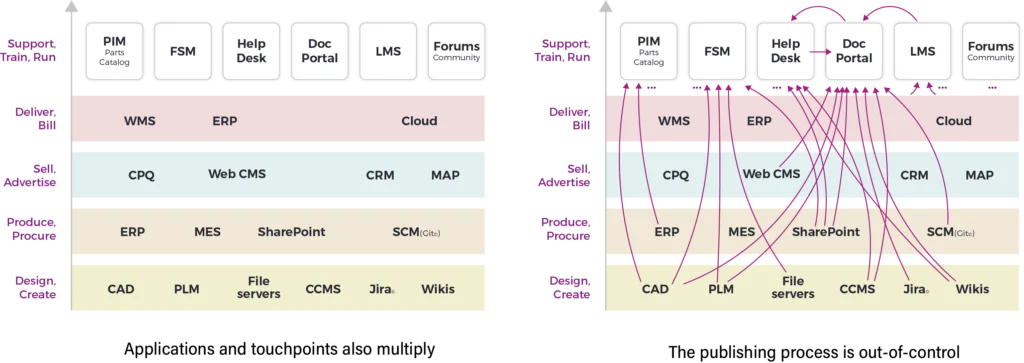
To reduce complexity and deliver consistent user experiences, businesses need an intermediary solution: a centralized content repository. This single source of truth lets content teams gather and manage all content in one place, then publish it to every channel—such as a knowledge base, CRM, website, or AI tools like chatbots.
A centralized repository is also essential for effective AI adoption. AI performs best when content is governed, easy to access, consistent, and tied to an authoritative source. By centralizing product knowledge, organizations make content easier to find and ensure both users and AI systems rely on the same accurate information.

Five minutes of manually moving content from point A to point B doesn’t sound like much, until you have six channels (30 minutes) and 20 languages (600 minutes, assuming five minutes per language per channel). Suddenly, you’ve spent hours just moving files around. Industry conversations mention that technical writers spend nearly half their time on ‘document maintenance’ tasks.
Sarah O’Keefe
Founder of Scriptorium Publishing, in The Business Case for Content Operations
Leverage the Right Tools
Gathering the best people and putting the right processes in place doesn’t matter without a solid tool stack to back them up. Depending on your business and strategy, there are different kinds of tools that may be valuable.
Content Authoring and Management Tools:
Writers from across teams have flexible documentation tools to create diverse, comprehensive documentation. This includes authoring tools, content quality assurance tools, editing tools, and more.
- Examples: CMS, CCMS (e.g. Paligo, Tridion Docs, Author-it, Componize…), Headless CMS, oXygen XML Editor, Acrolinx, etc.
Developer Documentation Tools:
For software companies, developers need a specific set of engineering tools where they can write code in different programming languages, collaborate on projects, and share content.
- Examples: Confluence, GitHub, Read the Docs, Doxygen, etc.
Project Management Tools:
Team leads and project managers use specific tools to help maximize efficiency, organize tasks, centralize project information, and facilitate collaboration within content operations.
- Examples: Jira, Notion, Asana, Trello, Monday, etc.
Product Knowledge Platforms:
Once teams have created and edited their documentation, they must still deliver the content to all endpoint applications. Product Knowledge Platforms (PKP) gather content in a centralized content repository and unify it no matter the initial source and format. They then feed the content to all delivery points (e.g. website, documentation portal, CRM, knowledge base, help desk, AI chatbot, etc.).
- Examples: Fluid Topics
Analytics Tools:
Just because content is live and accessible to users, doesn’t mean the workflow is done. Teams still need to track metrics and use analytics tools to extract insights into how users interact with the company and how effective the content is.
- Examples: Independent analytics tools (e.g. Google Analytics, SEMrush…) and documentation tools containing dedicated content analytics (e.g. Fluid Topics), etc.
Optimize Content for AI Understanding
Companies that want their content to perform well with AI systems need to integrate AI readiness directly into their content ops. Issues like fragmented context, semantic gaps, implicit knowledge assumptions, visual information dependencies, and non-friendly formats prevent AI from finding, understanding, and using key information. To prepare content for AI, writers need to integrate several practices:
- Use rich semantic elements
- Break content into granular text
- Integrate metadata and taxonomy
- Write with consistent terminology
- Apply cross linking and context mapping
- Provide text equivalents for visuals
- Keep layouts simple
- Add depth and breadth
Get your copy of the AI-Ready Documentation Checklist
Embrace Cross-Functional Collaboration
Designing clear workflows and streamlined processes keeps communication and collaboration running smoothly among writers, developers, designers, and other stakeholders. This helps content move efficiently through every stage of its lifecycle. Strong workflows also reinforce a transparent, efficient way of working across teams.
Uphold Strong Governance
Within content governance, teams must establish consistent content rules, style guidelines, quality assurance processes, and accessibility requirements. Each of these elements ensures teams maintain a high level of editorial standards.
How Does AI Impact Content Operations?
Generative AI optimizes the content workflow. GenAI has moved beyond experimentation and is now widely used in production. Common applications include creating first drafts, enforcing brand and style guidelines, preparing content for localization, and identifying content gaps.
Agentic AI enables end-to-end automation. Agentic AI goes beyond basic content generation. Instead of producing text in response to manual prompts, agentic systems independently work toward specific, defined goals with limited human oversight. They coordinate multiple AI agents that can reason, plan, and complete tasks while connecting to different tools and applications.
For content operations, this can automate entire documentation workflows—from research to publication—cutting coordination delays and reducing manual work.
Conclusion
Content operations have evolved beyond workflow management.
In 2026, successful organizations use content operations to transform product knowledge into a strategic business asset. By aligning people, processes, technology, and analytics, teams can deliver consistent experiences across documentation portals, support channels, self-service initiatives, and AI-powered applications.
Organizations that invest in centralized knowledge, strong governance, content reuse, and AI-ready content are better positioned to improve discoverability, support higher productivity, and accelerate AI adoption.
As a Product Knowledge Platform, Fluid Topics helps organizations unify content, deliver personalized experiences, power AI initiatives, and create a trusted foundation for both users and AI systems.
Schedule a free demo of Fluid Topics with a product expert
Editor’s Note: This post was originally published in February 2025. It has been completely edited and updated for accuracy and comprehensiveness.
Content Operations FAQs
Content operations platforms are collaborative digital spaces where teams can track the progress of documentation projects, approve or deny changes, manage content, and track results. These software solutions are essential to smooth operations.
Your AI Chatbot Is Only as Good as Your Documentation

 6 Technical Documentation Trends to Watch in 2026