

Industry Insights
GEO vs. SEO: Why Documentation Teams Need Both
SEO and GEO are not the same and each one deserves its own, dedicated strategy. Still, there are several practices that either overlap or clash between the two. Learn about the similarities, differences, and what you need to know to build strong SEO and GEO practices.

Welcome to “GEO for Documentation Teams,” an article series where we break down how modern documentation portals are upgrading user content experiences with advanced AI capabilities. This is the third post in the series. Don’t miss our other articles on why docs teams need a GEO strategy, an intro to answer engines, the benefits and challenges of GEO, how to prepare GEO-friendly content, and how to measure results.
Key insights
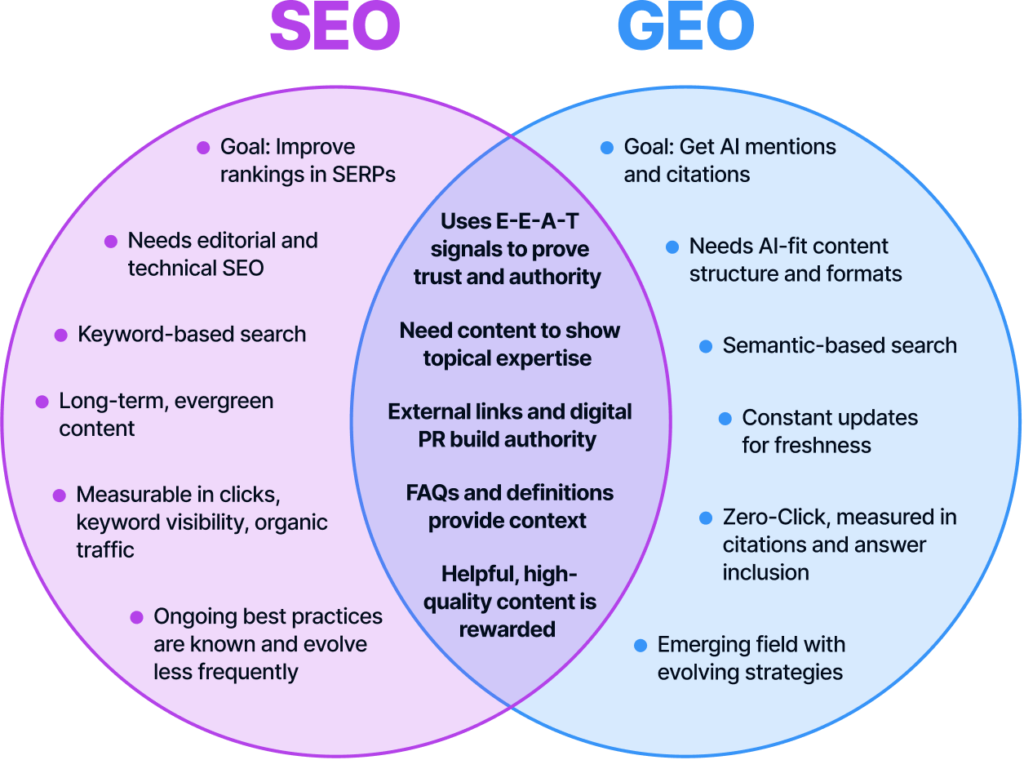
- SEO and GEO are similar in that they both address user intent, prioritize quality content, require logical content structure, look for E-E-A-T signals, require strong technical foundations, and use schema and metadata for clarity.
- SEO and GEO differ regarding their end goals, authority signals, editorial structural priorities, and freshness expectations.
- Embracing a dual-strategic approach as soon as possible is recommended given 83% of search users find AI search tools more efficient than traditional search engines.
After the emergence of Generative Engine Optimization (GEO), many people asked themselves the same questions: are GEO and SEO the same thing?
The simple answer is no, but they are closely related. SEO focuses on ranking in traditional search engine results pages, while GEO focuses on earning mentions and citations in AI-generated answers. However, both strategies share the same underlying goal of getting the right content in front of users when they need it. In the end, SEO authority and GEO visibility can reinforce each other rather than compete with the right strategies in place.
At the same time, relying only on existing SEO practices isn’t sufficient. GEO introduces requirements that affect how you write, beyond how you rank. Let’s break down the similarities, differences, and what you need to know to build strong SEO and GEO practices.
Where Do GEO and SEO Align?
An Ahrefs study found that high-traffic websites earn more mentions in AI answer engines. This suggests a clear connection between SEO authority and GEO visibility; strengthening one often boosts the other.

The relationship between SEO traffic and GEO traffic is real and positive, but it is not a straight line. Sites in the 21-to-25 percent SEO cohort get the most GEO traffic relative to their size. After that, additional SEO growth stops producing proportional GEO gains.
Neil Patel
Founder of NP Digital
To build a cohesive strategy, teams first need to understand which actions and approaches support both SEO and GEO.
- Both address user intent. Content that directly and relevantly answers a question performs well in both search results and AI responses. Writers must anticipate what users need when they look for certain types of information and make clear what knowledge is available in each document.
- Quality content is non-negotiable. Step-by-step instructions, concrete examples, and specific product terms beat vague, generic writing in both contexts. The more specificity and use cases writers add, the better humans and AI can understand product knowledge.
- Strong structure drives understanding. Clear headings, consistent formatting, and logical organization in the content structure help human readers navigate and help AI systems parse content.
- Expertise, Experience, Authoritativeness, and Trustworthiness (E-E-A-T) signals increase visibility. Elements like author information, transparent sources, and real use cases illustrate subject-matter expertise, strengthening both ranking and citation potential.
- Technical foundations matter. Technical SEO best practices are also important for GEO. Removing duplicate content, ensuring responsive design, improving page speed, and maintaining a robots.txt file support discoverability for search engines and AI crawlers alike.
- Schema and metadata clarify meaning. Structured metadata and schema markup help both AI systems and search engines understand what a page covers and when to surface it.
How are GEO and SEO Different?
To maximize results, it is just as important to understand how these strategies differ as it is to learn the similarities. The differences highlight where teams must develop dedicated strategies.
- Different end goals. SEO aims to drive clicks to your site. GEO aims to get AI to use your content in its answer, often with no click at all. When a successful interaction looks different, so does the approach to providing content.
- Different authority signals. SEO relies heavily on external backlinks to show authority around certain topics. GEO prioritizes third-party mentions, with or without links attached, since AI tends to trust outside opinions about a company more than the company’s own claims.
- Different structural priorities. SEO content is often built to maximize engagement and scroll depth, using longer introductions and internal links that encourage users to dig deeper and spend more time reading. GEO content needs explicit definitions, concise direct answers at the beginning of each section, and AI-friendly formatting that supports extraction over engagement. Here, editorial structure is meant to get to the point quickly so AI can find and extract useful knowledge easily.
- Different freshness expectations. SEO content can build authority over years with occasional updates to reflect industry developments and new examples. GEO favors the newest information, and AI systems continually replace older sources with more current ones.
How Much Is Search Behavior Actually Changing?
It’s clear that GEO requires a dedicated strategy, but is this an urgent need for teams? Or can a slower approach over time be just as efficient?
Recent studies suggest that user search behavior is transforming quickly. An estimated 80% of search users now rely on “zero-click” AI results at least 40% of the time. This behavior shift is driving a roughly 15–25% reduction in traditional SEO traffic. Another study found that 83% of customers report AI-powered tools to be more efficient than traditional search tools.
The evolution is already underway, so teams should act now to see results sooner. As AI search grows in popularity, teams shouldn’t abandon SEO. Traditional organic search is still a key driver of product visibility and a valuable source of user insights.
The key takeaway is that you need both strategies and should get started quickly. Together, SEO and GEO maximize reach across traditional search and AI answer platforms.
Moving Ahead With Two Separate Strategies
Teams need separate strategies for both SEO and GEO. However, they must also be aware of how they overlap and impact each other. That’s why those who are already working on documentation SEO are well-positioned to take on new GEO considerations. Together, SEO and GEO maximize the reach of technical information across traditional search and AI answer platforms.
Continue the journey in our GEO for documentation teams series with the article “2 Common GEO Challenges (and How to Solve Them)”.
GEO Playbook for Documentation Teams
Learn how to get AI answer engines to find, understand, and use your documentation in their responses to user questions.
SEO and GEO FAQ
It is unlikely that GEO will replace SEO anytime soon. Traditional search still drives meaningful traffic, and many AI tools like Google’s AI Overviews pull from the same ranked sources that SEO targets. The goal is simply to provide quality, relevant information for users no matter where or when they look for answers.
 7 Business Benefits of AI in Documentation Portals
 How to Make Your Documentation AI-Ready: A Practical Step-by-Step Guide